

Tiết lộ: Bài đăng này có thể nhận được khoản bồi thường từ các đối tác được liệt kê thông qua quan hệ đối tác liên kết mà bạn không phải trả phí. Điều này không ảnh hưởng đến xếp hạng của chúng tôi và ý kiến là của riêng chúng tôi. Tìm hiểu thêm tại đây.
Nếu bạn muốn có bài đánh giá Seeking Alpha chuyên sâu và chi tiết thì bạn đã đến đúng nơi.
Trước tiên, bạn sẽ tìm hiểu Seeking Alpha là gì, Seeking Alpha có thể mang lại lợi ích cho bạn và các khoản đầu tư của bạn như thế nào, sau đó chúng ta sẽ đi vào chi tiết hơn, chẳng hạn như:
Bạn có thể trở thành thành viên Seeking Alpha cơ bản miễn phí, đăng ký Gói cao cấp của Seeking Alpha (đó là những gì tôi sử dụng) hoặc bạn có thể sử dụng Gói Pro.
Bạn đã sẵn sàng xem Seeking Alpha có phải là nền tảng nghiên cứu đầu tư tốt nhất dành cho mình chưa?
Hãy cùng tìm hiểu ngay.
Đánh giá chung:
Được xếp hạng 4,8/5
Công cụ tùy chỉnh
Nội dung chất lượng cao
Phân tích chuyên sâu chứng khoán
Có thể gây nghiện
Giao diện phức tạp
Có thể áp đảo
Seeking Alpha là một nền tảng nghiên cứu đầu tư được thiết kế dành cho các nhà đầu tư từ trung cấp đến cao cấp, những người muốn có thông tin định lượng, khách quan và tiết kiệm chi phí.
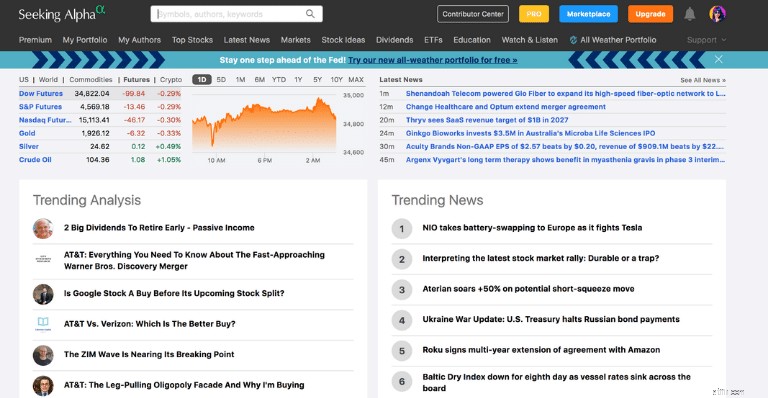
Một số công cụ bạn có thể bắt đầu sử dụng nếu đăng ký Seeking Alpha , bao gồm:
Kể từ khi Seeking Alpha ra đời vào năm 2004, nền tảng này đã thu hút hơn 20 triệu người dùng hàng tháng.
Đây là điều thú vị mà có thể bạn chưa biết về tên Seeking Alpha:
Thuật ngữ “alpha” không chỉ là chữ cái đầu tiên trong bảng chữ cái Hy Lạp mà còn được người Hy Lạp sử dụng để biểu thị số 1.
Thuật ngữ “alpha” thực chất cũng là một thuật ngữ tài chính và được biểu thị bằng ký hiệu sau:
Đây là ý nghĩa của thuật ngữ “alpha” về mặt tài chính:
Alpha của danh mục đầu tư thường được biểu thị dưới dạng số dương, số âm hoặc 0.
Dưới đây là ý nghĩa của những con số này:
2%
Danh mục đầu tư vượt trội hơn thị trường 2%
0%
Danh mục đầu tư được thực hiện phù hợp với thị trường
-2%
Danh mục đầu tư hoạt động kém hơn thị trường 2%
Vì vậy, trên thực tế, nền tảng Seeking Alpha có cách chơi chữ rất thông minh với tiêu đề của nó.
Seeking Alpha thể hiện mong muốn của chúng tôi là xây dựng một danh mục đầu tư có thể hoạt động tốt hơn thị trường.
Mục tiêu cuối cùng của Seeking Alpha là giúp các nhà đầu tư cơ bản chia sẻ thông tin và ý tưởng với các nhà đầu tư có cùng chí hướng trên nền tảng.
Sau khi đăng ký và trở thành thành viên Seeking Alpha, bạn sẽ được cấp quyền truy cập độc quyền vào các bài viết và bản tin được viết bởi các nhà đầu tư cơ bản có kinh nghiệm và được chứng nhận.

Chứng chỉ cao nhất liên quan đến đầu tư mà ai đó có thể đạt được (ngoài bằng tiến sĩ) là chứng chỉ CFA.
Mặc dù không phải mọi tác giả đều có thể có chứng chỉ CFA - điều này hoàn toàn bình thường - nhưng những tác giả có chứng chỉ CFA cũng là những ứng cử viên tuyệt vời để học hỏi.
Ngay cả khi đang sử dụng gói miễn phí của Seeking Alpha, bạn vẫn có thể truy cập vào:
Hãy xem một đoạn trong số rất nhiều bài viết được xuất bản hàng ngày:
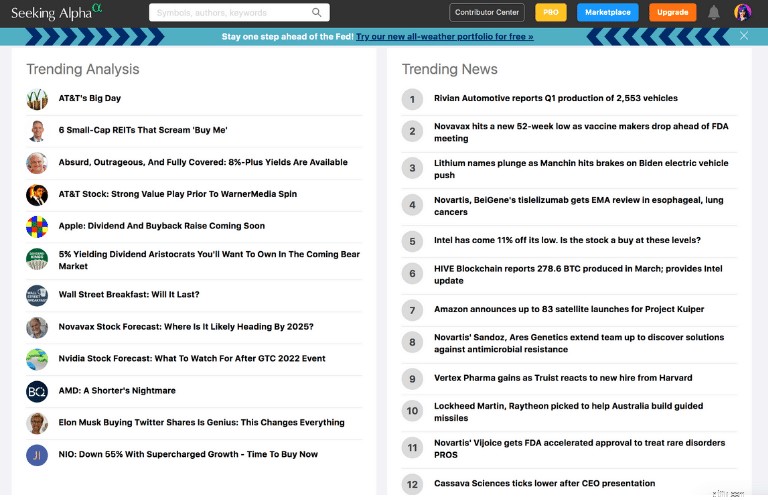
Trên thực tế, Seeking Alpha tự hào có hơn 7.000 tác giả năng động, giàu kinh nghiệm, xuất bản hơn 10.000 bài đánh giá chuyên sâu mỗi tháng.
Những tác giả này đi sâu vào cổ phiếu , xem xét tình hình tài chính của mỗi công ty và đưa ra ý kiến riêng của họ xem liệu cổ phiếu đó có phải là:
Giờ đây, ngoài việc học hỏi từ các nhà đầu tư chuyên nghiệp về từng cổ phiếu, Seeking Alpha còn mang đến cho bạn cơ hội thực hiện nghiên cứu của riêng mình.
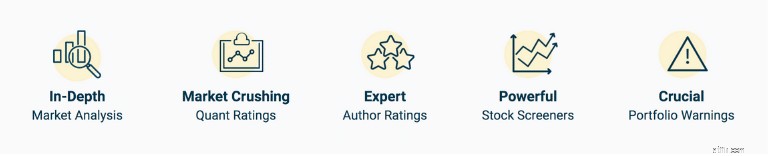
Một số công cụ nghiên cứu đơn giản mà mọi thành viên Premium và Pro đều có thể truy cập bao gồm:
Chúng ta sẽ đi vào chi tiết hơn về những công cụ này ở phần sau của bài viết (vì vậy hãy tiếp tục đọc nhé!).
Ý tưởng chính ở đây là Seeking Alpha mang đến cho bạn những điều tốt nhất của cả hai thế giới:Bạn có thể học hỏi và tương tác với các đồng nghiệp của mình cũng như nhận được kinh nghiệm thực tế khi nghiên cứu đầu tư.
Hãy cùng xem xét toàn cảnh những ưu và nhược điểm của Seeking Alpha (đối với các tùy chọn trả phí):
Tối thiểu hoặc không có quảng cáo
Đắt nếu bạn là nhà đầu tư bình thường
Truy cập vào các bản tin, bài phỏng vấn và bài viết độc quyền hàng ngày
Ít tin tức về tiền điện tử hơn so với các lĩnh vực khác
Phân tích định lượng sâu sắc về cổ phiếu
Tập trung vào nghiên cứu đầu tư và không tự động hóa khoản đầu tư của riêng bạn
Tùy chỉnh thông báo chứng khoán (bạn sẽ nhận được thông báo đẩy)
Khả năng sử dụng/giao diện có thể gây nhầm lẫn
Các bài viết được cộng đồng đóng góp mang lại cho bạn cơ hội tương tác trực tiếp với các tác giả
Hầu hết các bài viết và cổ phiếu chủ yếu tập trung vào Hoa Kỳ (và đôi khi là Canada)
Bạn có thể tùy chỉnh nhiều công cụ Seeking Alpha
Có thể phức tạp nếu bạn là nhà đầu tư thụ động (không giao dịch trong ngày)
Trước khi đọc thêm, hãy xem xếp hạng của tôi cho từng hạng mục trong số 6 hạng mục sau:
Thông tin chi tiết về đầu tư
⭐️⭐️⭐️⭐️⭐️
Công cụ đầu tư
⭐️⭐️⭐️⭐️⭐️
Dịch vụ khách hàng
⭐️⭐️⭐️⭐️⭐️
Khả năng sử dụng
⭐️⭐️⭐️⭐️⭐️
Chi phí
⭐️⭐️⭐️⭐️
Để cung cấp thêm một chút chi tiết về lý do xếp hạng của tôi, hãy xem bảng phân tích của tôi bên dưới:
Cho đến nay, tôi khá ấn tượng với Seeking Alpha.
Seeking Alpha được thành lập vào năm 2004 bởi David Jackson.
David từng là nhà phân tích nghiên cứu công nghệ và vốn cổ phần tại Morgan Stanley trong thời kỳ bong bóng công nghệ, nghiên cứu cổ phiếu và viết ra những phát hiện của mình.
Trong thời gian này, David nhận ra rằng có xung đột lợi ích cố hữu nếu các ngân hàng đầu tư lớn công bố nghiên cứu của họ về một số sản phẩm đầu tư nhất định, đặc biệt nếu các ngân hàng lớn bán các sản phẩm đầu tư này.
Tại sao một ngân hàng đầu tư lớn lại xuất bản một bài nghiên cứu về một sản phẩm kém chất lượng mà chính ngân hàng đó bán?
Đó là lý do Seeking Alpha ra đời.
Dưới đây là một số chi tiết khác bạn nên biết về Seeking Alpha:
Năm thành lập
2004
Địa điểm trụ sở chính
Ra'anana, Israel
Người dùng hàng tháng
20 triệu+
Người xem hàng tháng
40 triệu+
Tác giả hoạt động hàng tháng
7.000+
Các bài báo xuất bản hàng tháng
10.000+
Chi phí hàng tháng
– Quyền truy cập hạn chế =$0
– Phí bảo hiểm =$19,99
– Chuyên nghiệp =$199,99
Ai nên sử dụng Seeking Alpha
– Nhà đầu tư trung gian
– Nhà đầu tư nâng cao
– Người giao dịch trong ngày
Loại nội dung
– Podcast
– Nội dung video
– Nội dung bằng văn bản
Tính năng nổi bật
– Báo cáo tài chính
– Bảng điểm cuộc gọi thu nhập
– Thông báo chứng khoán tùy chỉnh
– Phân tích chuyên sâu từ chuyên gia
– Hệ thống xếp hạng cổ phiếu minh bạch
– Biểu đồ so sánh hiệu suất cổ phiếu
Sẵn có
– iPad
– Máy tính để bàn
– Android
– iPod touch
– iPhone (iOS 12.2 trở lên)
Dịch vụ khách hàng
– Điện thoại
– Diễn đàn
Giờ phục vụ khách hàng
Thứ Hai đến Thứ Sáu, 8 giờ sáng đến 4 giờ chiều theo giờ EST
Quốc gia sẵn có
Quốc tế
Mặc dù Seeking Alpha có sẵn cho khán giả quốc tế nhưng tôi cần lưu ý rằng trọng tâm nghiên cứu đầu tư chính của nền tảng này là ở Hoa Kỳ và Canada.
Tôi là một fan hâm mộ lớn của giao diện trang web Seeking Alpha.
Cá nhân tôi thấy Seeking Alpha rất thân thiện với người dùng, trực quan và nó cũng làm rất tốt việc hiển thị thông tin một cách có tổ chức.
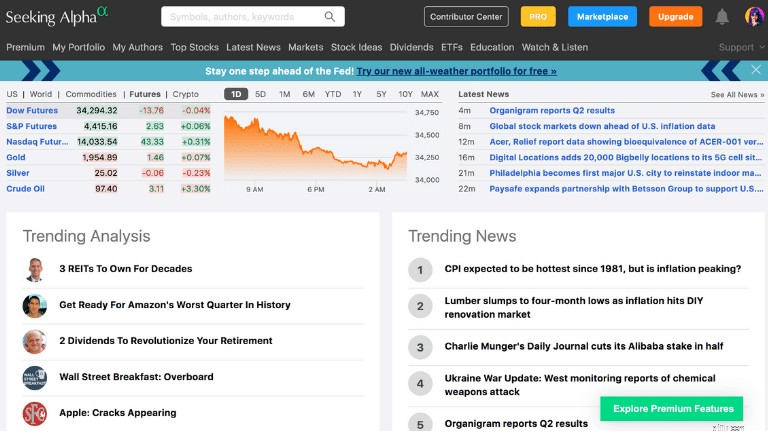
Bây giờ, phản hồi mang tính xây dựng duy nhất mà tôi có là dành cho những nhà đầu tư mới bắt đầu – và ngay cả đối với những người dùng trung cấp – thông tin về Seeking Alpha không phải lúc nào cũng được tìm thấy bằng trực giác.
Ví dụ:nếu bạn đang tìm kiếm quỹ ETF hàng đầu tại các thị trường mới nổi, có thể bạn sẽ không biết tìm ở đâu.
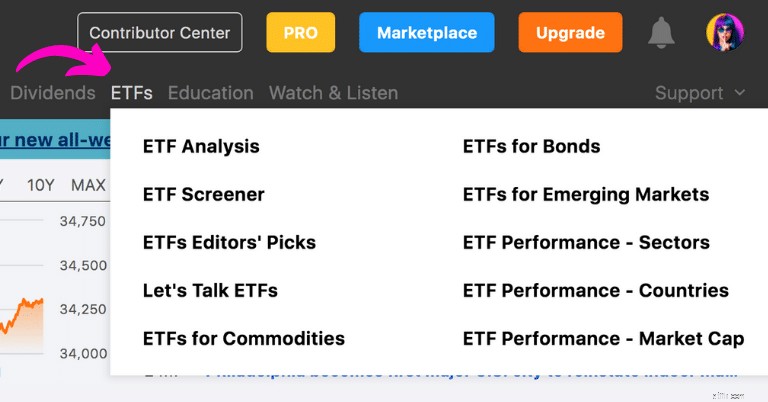
Nơi hợp lý duy nhất mà tôi có thể tìm kiếm các quỹ ETF ở các thị trường mới nổi sẽ là trong tab ETF – nhưng vẫn không có thêm thông tin nào về các quỹ ETF ở các thị trường mới nổi.
Trên thực tế, để tìm các quỹ ETF hàng đầu tại các thị trường mới nổi, bạn sẽ phải nhấp vào “Trình sàng lọc ETF” và “Hiệu suất ETF – Khu vực”.
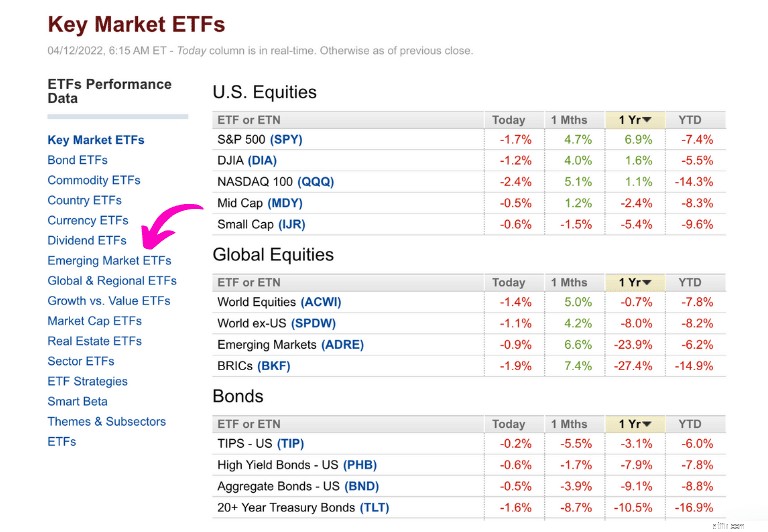
Từ đó, bạn sẽ phải nhấp vào thanh công cụ bên trái để thực sự sắp xếp danh mục ETF (trong trường hợp này là các thị trường mới nổi) mà bạn đang tìm kiếm.
Nhìn chung, Seeking Alpha đã xây dựng một nền tảng nghiên cứu cơ bản tuyệt vời cho mọi nhà đầu tư.
Có thể bạn sẽ chỉ cần trải qua một khoảng thời gian học tập nhỏ trước khi hoàn toàn quen thuộc với nền tảng này và cách thức hoạt động của nó.
Seeking Alpha có 3 gói, trong đó có 2 gói trả phí:
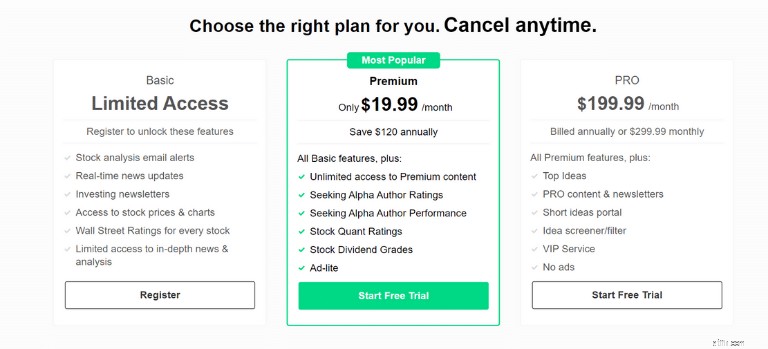
Tôi sử dụng Gói cao cấp và tôi rất hài lòng với chức năng cũng như các tính năng của gói này.
Đây là những gì bạn có thể mong đợi khi mở tài khoản với Seeking Alpha:
Chi phí tối thiểu
$0 [Gói truy cập có giới hạn]
Chi phí tối đa
$199,99/tháng [Gói chuyên nghiệp]
Phương thức thanh toán
– PayPal
– Thẻ tín dụng
Hãy nhớ rằng gói Premium (hoặc Gói Pro) của bạn sẽ được lập hóa đơn hàng năm để nhận được chi phí hàng tháng là 19,99 USD (Cao cấp) hoặc 199,99 USD (Pro).
Nếu không, bạn sẽ phải trả 29,99 USD/tháng (Cao cấp) và 299,99 USD/tháng (Pro).
Dưới đây là tổng quan ngắn gọn về những gì bạn nhận được với mỗi Gói đăng ký Seeking Alpha:
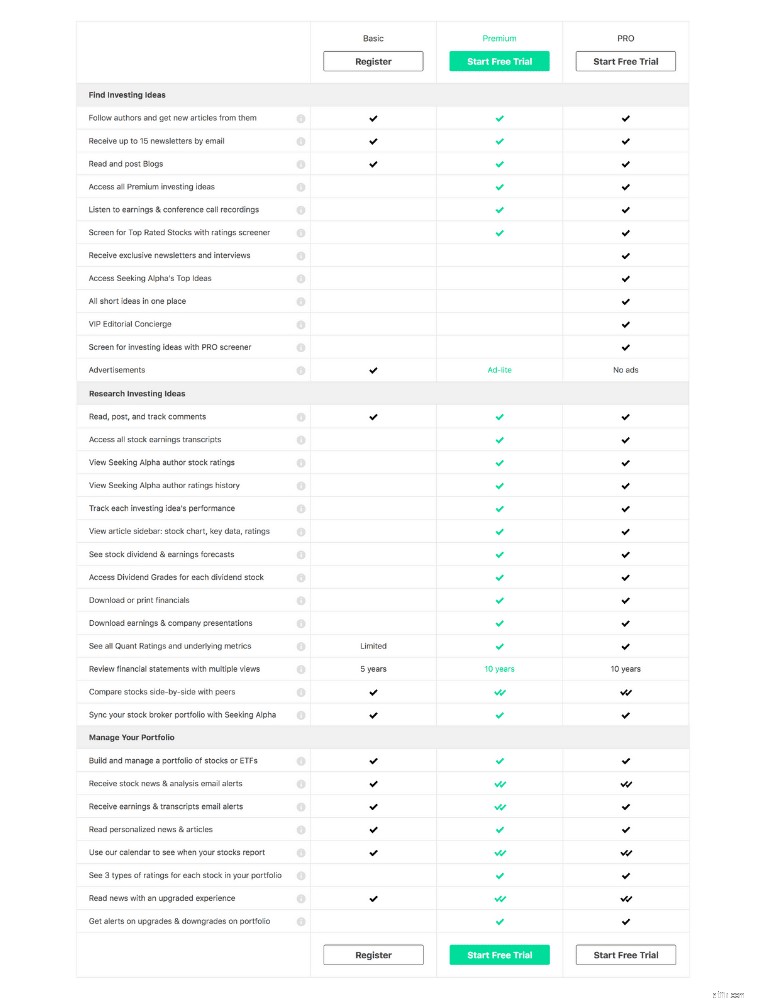
Tin vui là bạn có thể bắt đầu dùng thử miễn phí 14 ngày với Gói cao cấp và thậm chí cả Gói chuyên nghiệp.
Thông thường, bạn sẽ nhận được email nhắc nhở vài ngày trước khi thời gian dùng thử kết thúc, nhưng tôi đã đọc một số khiếu nại rằng thẻ tín dụng đã bị tính phí ngay khi thời gian dùng thử kết thúc.
Hãy tiếp tục đọc đoạn văn sau vì tôi sẽ giải thích chi tiết hơn về từng dịch vụ và những gì bạn nhận được với số tiền bỏ ra.
Liệu gói Seeking Alpha có đáng giá hay không thực sự phụ thuộc vào bạn và mục tiêu của bạn.
Dưới đây, tôi đã chia nhỏ một biểu đồ đơn giản để cho bạn biết kế hoạch nào có thể phù hợp nhất nếu bạn:
Đọc bài viết hàng ngày
✔️
✔️
Tương tác với tác giả
✔️
✔️
Thông báo qua email
✔️
✔️
Không có quảng cáo
✔️
Tận hưởng phân tích
✔️
✔️
Muốn có dịch vụ VIP
✔️
Muốn có nội dung độc quyền
✔️
Là người giao dịch trong ngày
✔️
✔️
Tiền không phải là điều đáng lo ngại
✔️
Cá nhân tôi nghĩ gói Premium là hoàn hảo cho những ai là người bình thường và muốn:
Trừ khi bạn thực sự là một nhà giao dịch hàng ngày hoặc điều hành doanh nghiệp nhỏ của riêng mình và cần thêm sự tiếp cận độc quyền, tôi cho rằng Gói đặc biệt có lẽ là giá trị tốt nhất, xét đến số tiền bạn đang chi tiêu.
Mặc dù gần như không thể đánh bại thị trường một cách nhất quán nhưng Seeking Alpha chắc chắn sẽ mang lại cho bạn lợi thế để vượt trội hơn thị trường.
Trên thực tế, kể từ năm 2010, thuật toán định lượng của Seeking Alpha đã vượt trội đáng kể so với S&P 500, đánh bại nó 9/10 lần.
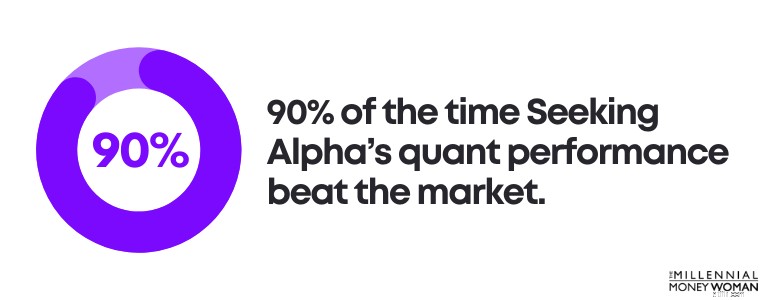
Các cổ phiếu “Rất tăng giá” mang lại lợi nhuận 1,754% trong khi S&P 500 chỉ mang lại lợi nhuận 385%.
Vậy làm cách nào để bạn có quyền truy cập vào một công cụ giúp tăng đáng kể tỷ lệ cược của bạn để vượt trội hơn thị trường?
Bằng cách đăng ký Gói Seeking Alpha Premium .
Hãy nghĩ về nó theo cách này:
Chỉ cần lưu ý rằng hiệu suất trong quá khứ không nhất thiết phản ánh hiệu suất trong tương lai.
Nếu bạn chưa sẵn sàng chi tiền cho Seeking Alpha và chỉ muốn đăng ký gói miễn phí thì hãy xem phần này, dành riêng cho Gói truy cập có giới hạn:
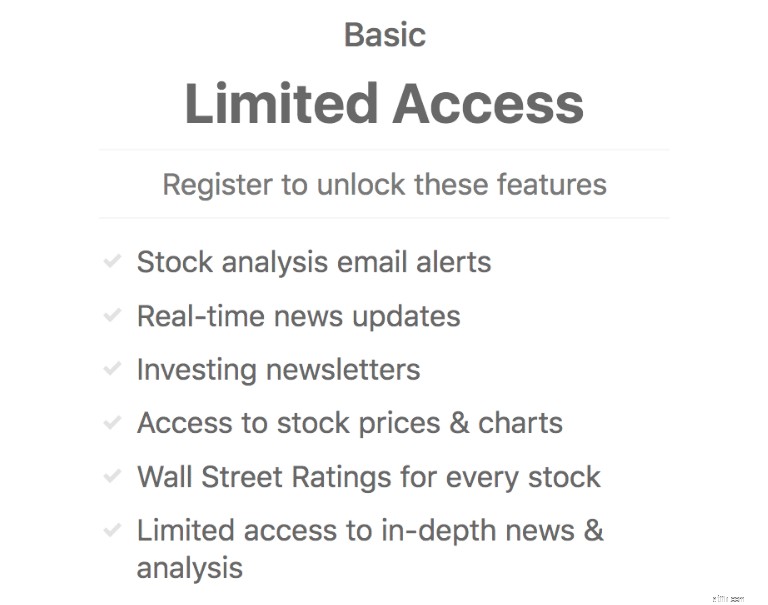
Với gói Quyền truy cập hạn chế, một số việc bạn có thể làm bao gồm:
Một số nhược điểm của gói Quyền truy cập hạn chế bao gồm:
Nếu bạn thấy mình quan tâm và muốn nhiều hơn nữa, hãy cân nhắc đăng ký một trong các Gói trả phí của Seeking Alpha (Bản Premium hoặc Pro).
Điều thú vị về gói Seeking Alpha Premium (và Pro) là bạn có thể bắt đầu Thời gian dùng thử miễn phí 14 ngày để kiểm tra gói trước khi bạn cam kết tài chính.
Bạn có thể hủy thời gian dùng thử bất kỳ lúc nào để đảm bảo bạn không bị tính toàn bộ số tiền (điều mà Seeking Alpha có thể làm nếu bạn không hủy trước khi thời gian dùng thử kết thúc).
Nếu bạn thích thời gian dùng thử Gói cao cấp thì bạn có thể thanh toán cho Gói cao cấp theo 3 cách:
Gói hàng tháng
29,99 USD/tháng
Gói hàng năm
$239 (hoặc $19,99/tháng, như được quảng cáo)
Kế hoạch 3 năm
$540 (hoặc $14,99/tháng)
Có vẻ như trường hợp mặc định của Seeking Alpha là tính phí trả trước cho cả năm (tức là $239 cho Gói Premium).
Một trong những lợi ích lớn nhất khi đăng ký Gói đặc biệt so với gói Truy cập hạn chế là bạn có quyền truy cập độc quyền vào cộng đồng nhà đầu tư, vì vậy bạn có thể:
Tôi là người dùng Gói đặc biệt và điều tôi thích nhất là bạn có thể lên ý tưởng theo đúng nghĩa đen với đồng nghiệp về khoản đầu tư tiếp theo của mình.
Trong phần này, tôi sẽ giải thích chi tiết một số tính năng của Gói Premium mà tôi yêu thích và cách bạn có thể hưởng lợi từ mỗi tính năng.
Dưới đây là thông tin tổng quan về các tính năng của Seeking Alpha Premium:
Nếu bạn muốn biết thêm về những tính năng này, hãy tiếp tục đọc.
Không giống như gói Truy cập có giới hạn, có thể có nhiều quảng cáo, Gói cao cấp cung cấp trải nghiệm người dùng “ad-lite”.
Ví dụ:bạn có thể nhận được một số quảng cáo biểu ngữ trong quá trình duyệt web của mình, chẳng hạn như sau:
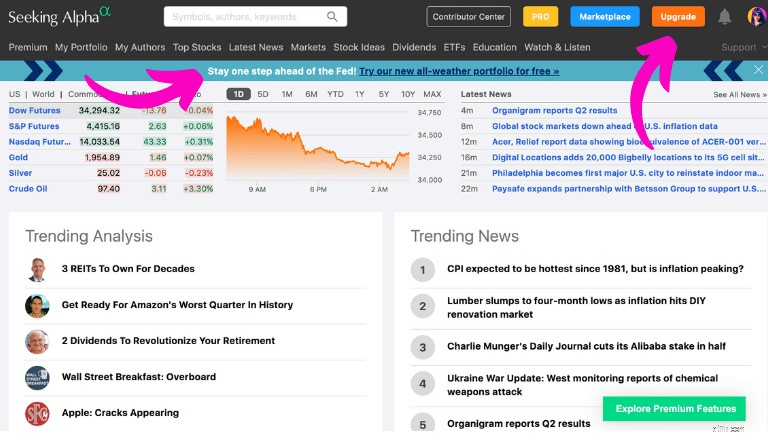
Như bạn có thể thấy với đăng ký Premium của tôi, Seeking Alpha có quảng cáo một số sản phẩm của mình (trong trường hợp này là gói Pro).
Thành thật mà nói, tôi không thực sự thấy phiền bởi những quảng cáo này và không nghĩ chúng làm mất đi trải nghiệm của tôi.
Bạn đang tự hỏi liệu một cổ phiếu được định giá quá cao hay bị định giá thấp?
Hãy xem Xếp hạng của Phố Wall cho cổ phiếu đó và cuộn đến phần “Mục tiêu giá”.
Trong trường hợp này, tôi lấy Google làm ví dụ. Vì vậy, hãy xem mục tiêu giá của Google (và tính đến tháng 4 năm 2022, Google giao dịch ở mức 2.595,93 USD).
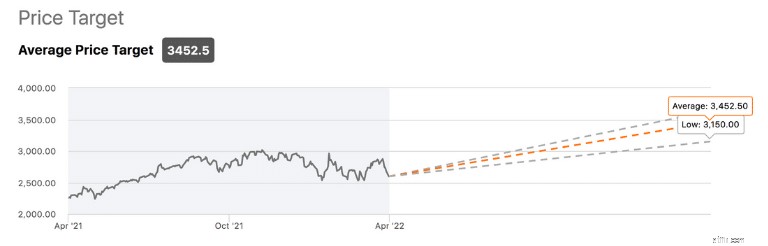
Nói cách khác, dựa trên mục tiêu giá ($3.452,50) so với giá thực tế của cổ phiếu ($2.595,93), cổ phiếu Google thực sự bị định giá thấp.
Đó có lẽ là lý do tại sao 98% nhà phân tích trong phần Xếp hạng của Phố Wall đánh giá Google là “Nên mua” hoặc “Rất nên mua”.
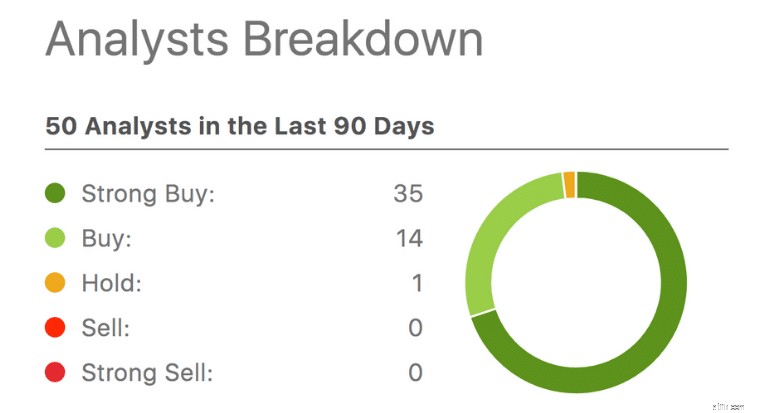
Biểu đồ bên dưới là một ví dụ rõ ràng khác về hàm mục tiêu giá.
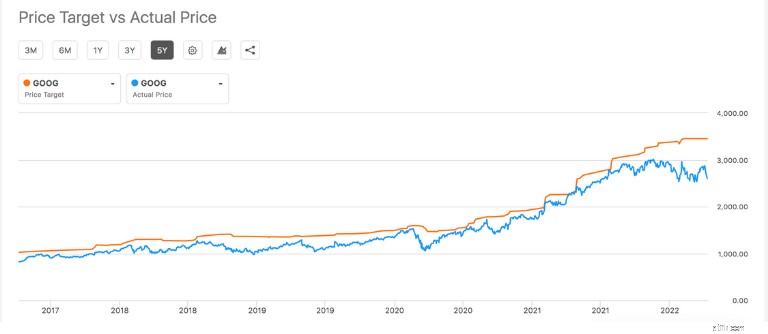
Trong biểu đồ Giá mục tiêu so với Giá thực tế, bạn sẽ thấy rằng mục tiêu giá (màu đỏ) hầu như luôn cao hơn một chút so với giá thực tế của Google (màu xanh lam).
Vì vậy, nếu bạn là nhà đầu tư giá trị đang tìm mua những cổ phiếu hiện đang bị định giá thấp, bạn có thể muốn coi Google là một khoản đầu tư.
Bây giờ, bạn cũng có thể nhớ đến sự thất bại của GameStop ($GME) vào đầu năm 2021, khi các nhà giao dịch trên Reddit đổ tiền vào cổ phiếu GME đang thất bại, gây ra một số rào cản tài chính lớn cho các quỹ phòng hộ và nền tảng đầu tư như Robinhood.
Đúng vậy, một số người có thể đã kiếm được tiền từ câu chuyện ngắn ngủi này, nhưng hầu hết đều có thể bị mất tiền.
Hãy xem biểu đồ Mục tiêu giá bên dưới, biểu đồ này có thể cho bất kỳ nhà đầu tư lý trí nào thấy rằng việc cày tiền bằng $GME là một động thái rủi ro:
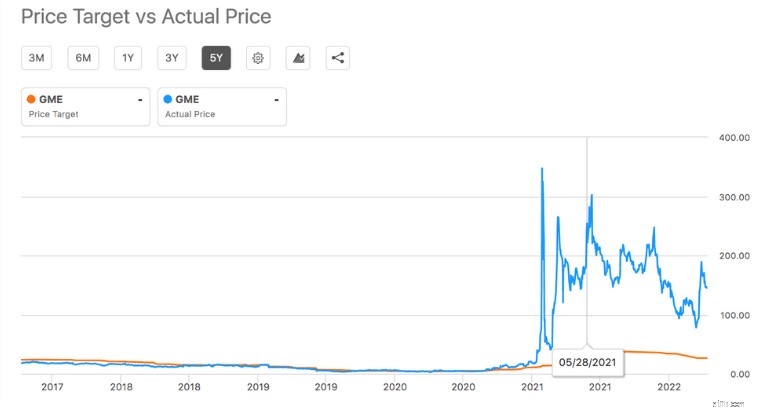
Như bạn có thể thấy, mục tiêu giá (màu đỏ) luôn dao động quanh mức vài đô la trong khi có thời điểm giá $GME thực tế đã tăng lên hơn 300 đô la.
Hãy nhớ rằng chỉ tập trung vào 1 điểm dữ liệu, chẳng hạn như mục tiêu giá, không phải là yếu tố quyết định việc bạn mua hay bán một cổ phiếu. Mục tiêu giá chỉ đơn giản là một hướng dẫn cần được xem xét cùng với các thông tin khác.
Nếu bạn là một nhà đầu tư trung gian đang tìm kiếm các ý tưởng đầu tư mới, bạn có thể muốn đăng ký Những cuộc gọi đáng chú ý của Seeking Alpha.
Bạn có thể đăng ký Cuộc gọi đáng chú ý và nhận các ý tưởng tổng hợp và tóm tắt từ các công ty trên khắp thế giới.
Bạn có thể đọc phần Cuộc gọi đáng chú ý bằng cách nhấp vào “Tin tức mới nhất” rồi nhấp vào “Cuộc gọi đáng chú ý”.
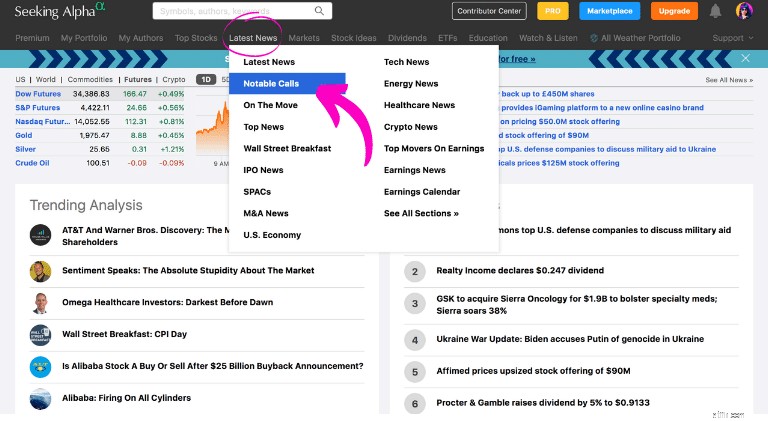
Khi ở trong phần Cuộc gọi đáng chú ý, bạn có thể khám phá các chủ đề khác nhau (bất kỳ chủ đề nào từ cáp quang đến các thương hiệu quần áo như Levi Strauss).
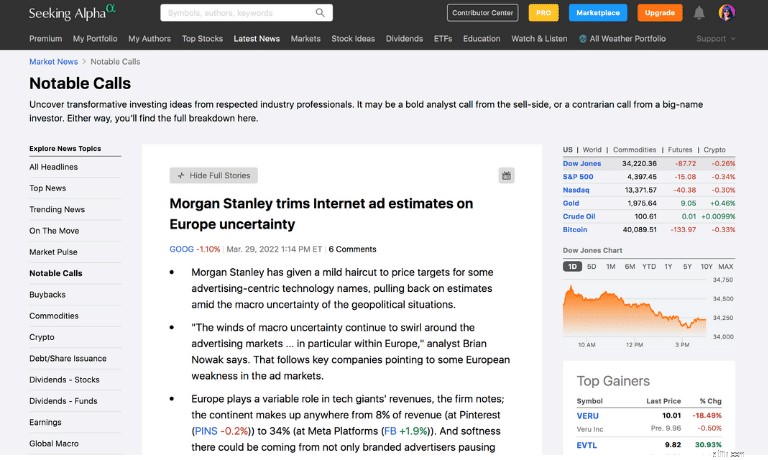
Các Cuộc gọi đáng chú ý không được công bố hàng ngày – đôi khi thậm chí có thể mất một tháng để thông tin mới xuất hiện trong phần Cuộc gọi đáng chú ý.
Vì các bài viết về Cuộc gọi đáng chú ý không được xuất bản nhất quán nên hãy nhớ tiếp tục đọc các bài viết cộng tác từ các tác giả là chuyên gia của Seeking Alpha để thu thập thêm ý tưởng đầu tư.
Vì Seeking Alpha là một nền tảng cung cấp dịch vụ cộng đồng nên không có gì ngạc nhiên khi mỗi cổ phiếu đều có xếp hạng của tác giả Seeking Alpha.
Ví dụ:nếu xem trang tóm tắt của AT&T Inc., bạn sẽ thấy Xếp hạng cho cổ phiếu $T được chia nhỏ theo danh mục:
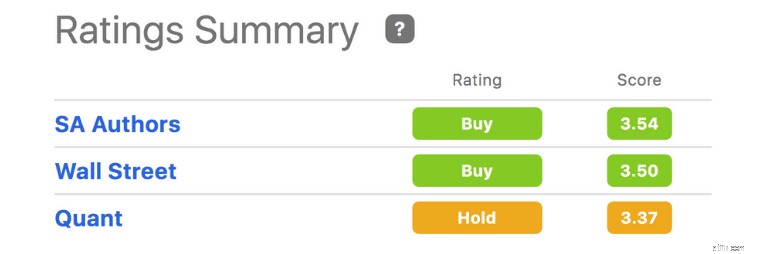
Để tìm hiểu thêm về xếp hạng tác giả của Seeking Alpha, hãy nhấp vào siêu liên kết “SA Authors” màu xanh lam.
Tại đây, bạn sẽ thấy Xếp hạng của tác giả Seeking Alpha cho một cổ phiếu dưới dạng:
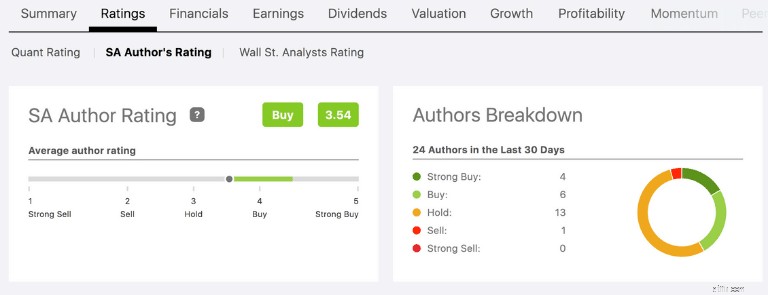
Trong số các yếu tố khác, bạn sẽ thấy xếp hạng Xếp hạng tác giả Alpha đang tìm kiếm và Phân tích tác giả cho mỗi xếp hạng.
Trong trường hợp của AT&T, 10 trong số 24 tác giả khuyến nghị Mua hoặc Rất Mua cổ phiếu (khoảng 42%).
Hơn nữa, bạn cũng có thể xem lại hồ sơ theo dõi Xếp hạng tác giả trong vài năm qua:
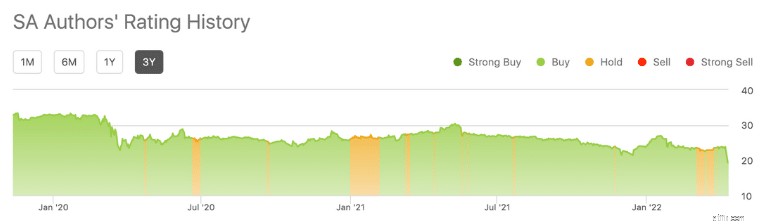
Dựa trên biểu đồ này, các tác giả của Seeking Alpha thường đưa ra khuyến nghị “Mua” hoặc “Rất nên mua” AT&T trong 3 năm qua.
Gần đây các tác giả đã đề xuất “Giữ” thay vì mua.
Cuối cùng, bạn cũng có thể chọn xem lịch sử xếp hạng theo tác giả:
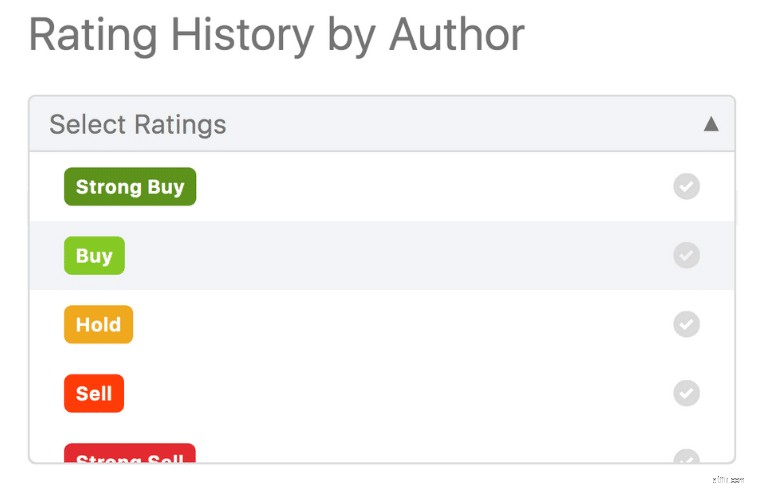
Vì vậy, nếu bạn tò mò muốn xem tác giả nào xếp hạng AT&T là đề xuất “Mua” hay “Bán” chẳng hạn, thì đây là nơi để làm điều đó.
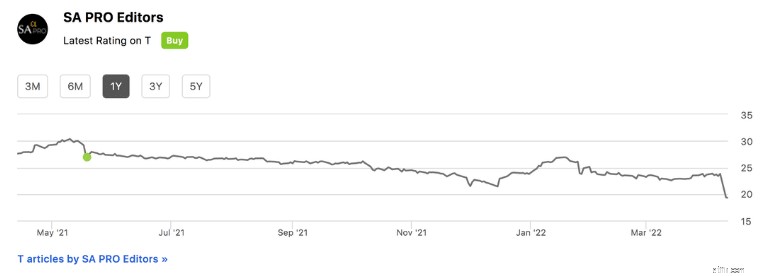
Trên đây là ảnh chụp màn hình của một tác giả khuyến nghị Mua cổ phiếu AT&T.
Nếu bạn thắc mắc tại sao tác giả lại khuyến nghị làm như vậy, bạn có thể nhấp vào siêu liên kết màu xanh lam để đọc về các bài viết về AT&T của tác giả.
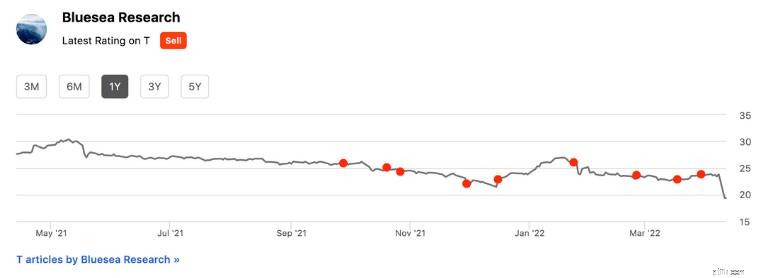
Tương tự, nếu bạn tìm thấy một tác giả đề xuất bán cổ phiếu $T, bạn có thể biết thời điểm tác giả đề xuất làm như vậy (xem các chấm màu đỏ trên biểu đồ so với hiệu suất của cổ phiếu $T).
Một lần nữa, bạn có thể đọc các bài viết của tác giả đó trên AT&T bằng cách nhấp vào siêu liên kết màu xanh lam bên dưới biểu đồ bán hàng của tác giả.
Nếu bạn là nhà đầu tư cổ tức , đây là một trong những tính năng thú vị nhất mà bạn có thể tìm thấy:Công cụ xếp hạng cổ tức.
Nói tóm lại, công cụ Mức cổ tức được thiết kế để giúp các nhà đầu tư xác định liệu cổ tức có an toàn hay không và liệu thu nhập từ cổ tức sẽ ổn định, tăng hay có thể giảm.
Có 4 mức cổ tức khác nhau được giải thích bên dưới:
An toàn cổ tức
Đo lường khả năng sinh lời và tính ổn định của cổ tức
Tăng trưởng cổ tức
Đo lường tiềm năng tăng trưởng của cổ tức bằng cách sử dụng tốc độ tăng trưởng trước đây và ước tính (bao gồm doanh thu, dòng tiền, lợi nhuận, v.v.)
Lợi tức cổ tức
Đo lường lợi suất lịch sử của cổ tức và so sánh lợi suất với các cổ phiếu khác trong cùng ngành để xác định lợi tức trong tương lai của cổ tức
Sự nhất quán về cổ tức
Đo lường tính nhất quán trong việc thanh toán cổ tức và tăng cổ tức của công ty
Một lý do khiến các nhà đầu tư, đặc biệt là các nhà đầu tư thụ động, thích chia cổ tức đến vậy là vì cổ tức là một dạng thu nhập thụ động .
Và, bạn càng mua nhiều cổ phiếu trả cổ tức thì theo thời gian, bạn thực sự có thể bắt đầu kiếm được một số tiền chỉ thông qua cổ phiếu trả cổ tức.
Hãy xem Mức cổ tức hiện tại của AT&T (tính đến tháng 4 năm 2022):
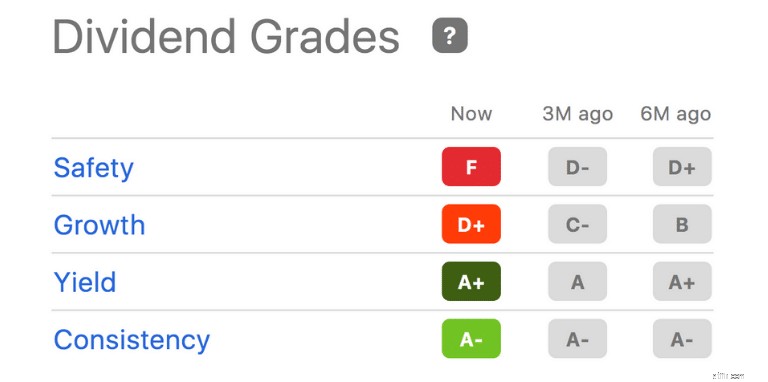
Điều tôi thích ở Điểm cổ tức là bạn có thể xem điểm hiện tại so với điểm của 3 tháng trước và thậm chí 6 tháng trước.
Rõ ràng, sự an toàn về cổ tức của AT&T đang gặp rủi ro. Điều này có nghĩa là AT&T có thể giảm hoặc thậm chí loại bỏ cổ tức.
Và đó là sự thật – hãy nhìn vào biểu ngữ cảnh báo màu đỏ khi tôi nhập $T vào thanh tìm kiếm:
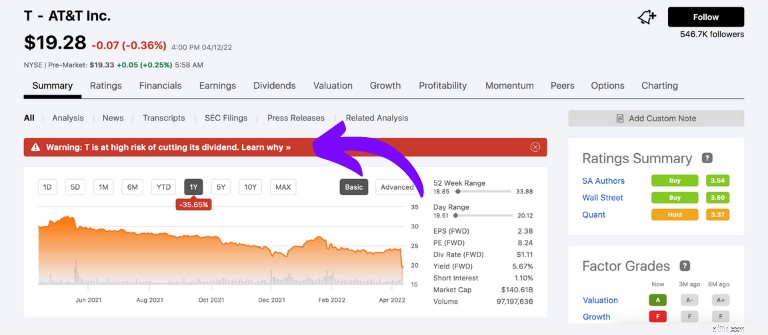
Thậm chí không cần nhìn vào Mức cổ tức, tôi đã được thông báo ngay lập tức rằng AT&T có thể cắt giảm cổ tức.
Nếu bạn muốn tìm hiểu thêm về nó, chỉ cần nhấp vào biểu ngữ:
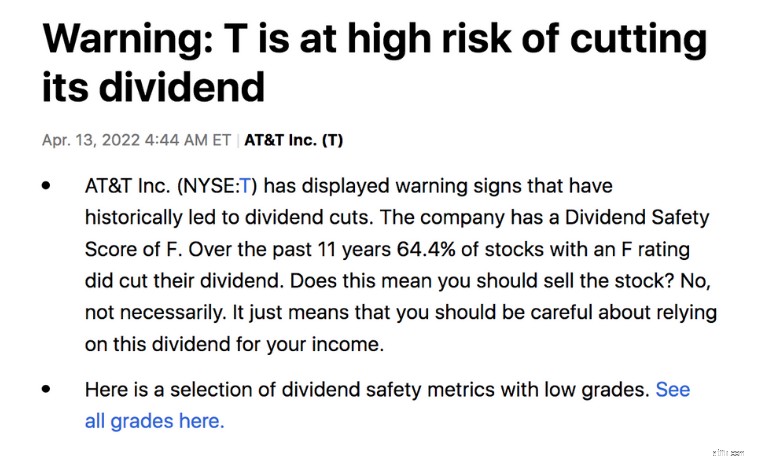
Bạn sẽ được chuyển hướng đến một bài viết phân tích sâu hơn về lý do tại sao AT&T có thể cắt giảm cổ tức trong tương lai gần.
Bây giờ, nếu bạn muốn tìm hiểu sâu hơn về từng Hạng cổ tức, chỉ cần nhấp vào siêu liên kết màu xanh lam của từng Hạng cổ tức:
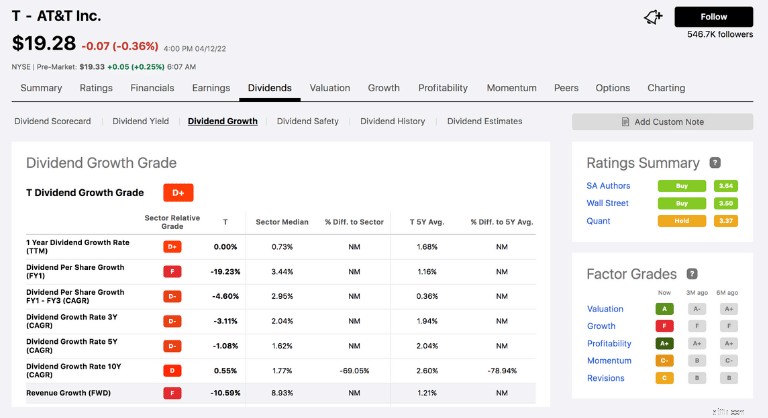
Ví dụ:trong ảnh chụp màn hình ở trên, bạn sẽ thấy một đoạn ngắn về mức độ hiểu sâu của bạn chỉ bằng cách đọc về Mức tăng trưởng cổ tức.
Tôi thích xem tab Lịch sử cổ tức hơn, trông giống như thế này:
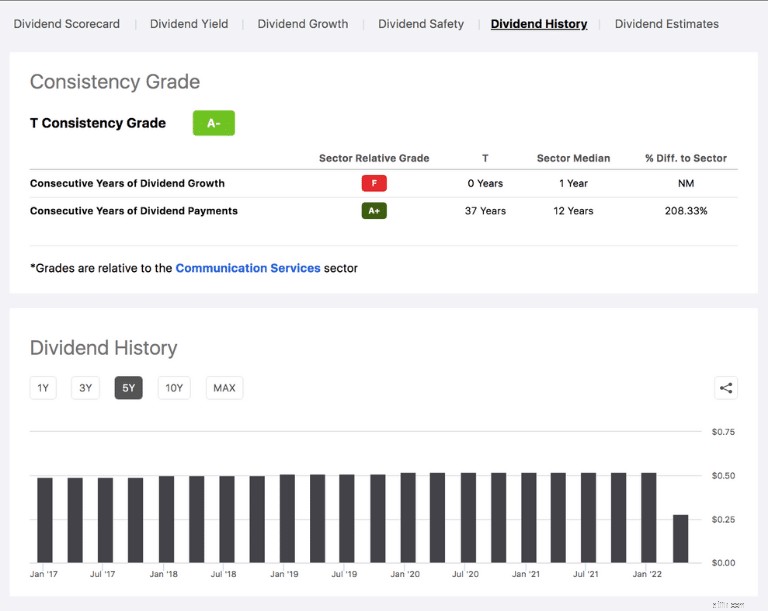
Như bạn có thể thấy, trong 5 năm qua, AT&T có lịch sử chia cổ tức rất ổn định – nhưng tính đến ngày 12 tháng 4 năm 2022, cổ tức đã giảm từ 0,52 USD xuống 0,28 USD.
Đó là một mức cắt giảm rất mạnh và thường báo hiệu mối lo ngại của các nhà đầu tư.
Cuối cùng, nếu bạn muốn tìm hiểu thêm về Ước tính cổ tức trong tương lai (không nằm trong 4 mức cổ tức ban đầu), bạn có thể nhấp vào tab tương ứng:
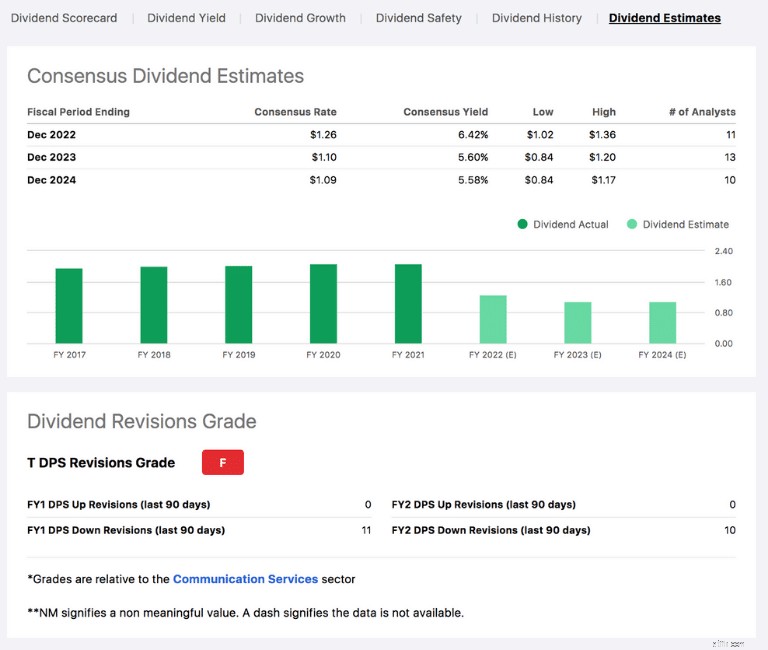
Như bạn có thể thấy, ước tính tăng trưởng cổ tức không dự đoán tỷ suất cổ tức sẽ quay trở lại mức ban đầu của AT&T, ít nhất là trong vài năm tới.
Nếu bạn là người chỉ muốn đọc những tin tức chứng khoán quan trọng và cấp bách nhất mà không đi sâu vào chi tiết thì hãy sử dụng Trang tổng quan tin tức.
Bạn có thể truy cập Trang tổng quan tin tức bằng cách nhấp vào tab “Tin tức mới nhất”.
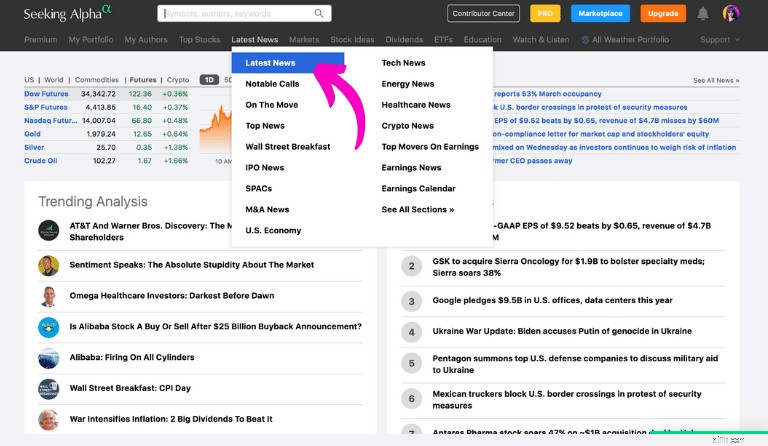
Sau khi nhấp vào tab “Tin tức mới nhất”, bạn sẽ được chuyển hướng đến trang có tiêu đề “Tin tức thị trường”.
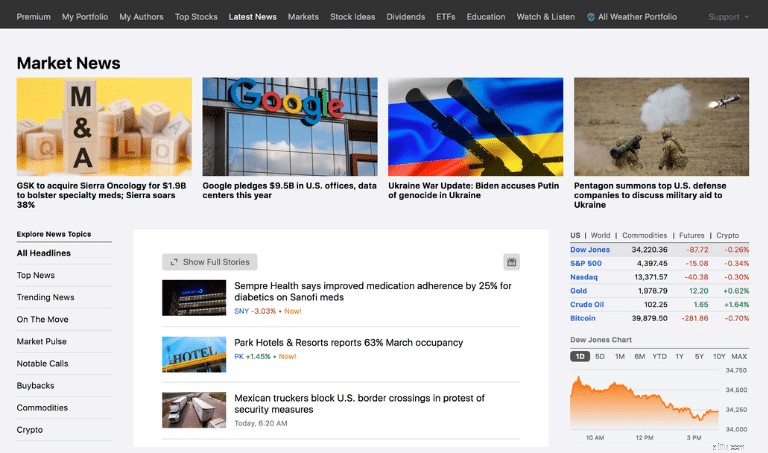
Từ trang tổng quan này, bạn có thể sử dụng bộ lọc (ở bên trái) để khám phá các chủ đề phù hợp với mình.
Bạn thậm chí có thể đặt phạm vi ngày để tập trung các bài đọc của mình vào một khung thời gian nhất định.
Tương tự như Điểm cổ tức, bạn cũng có thể thấy thứ mà Seeking Alpha gọi là Thẻ điểm yếu tố.
Nói cách khác, thẻ điểm là một công cụ giúp bạn đưa ra quyết định nhanh chóng về việc nên xem xét hay loại trừ một cổ phiếu, dựa trên tiêu chí đầu tư của bạn.
Thẻ điểm Yếu tố sử dụng 5 yếu tố, bao gồm:
Hãy cùng xem Thẻ điểm yếu tố dành cho $GME, hay còn gọi là Gamestop.
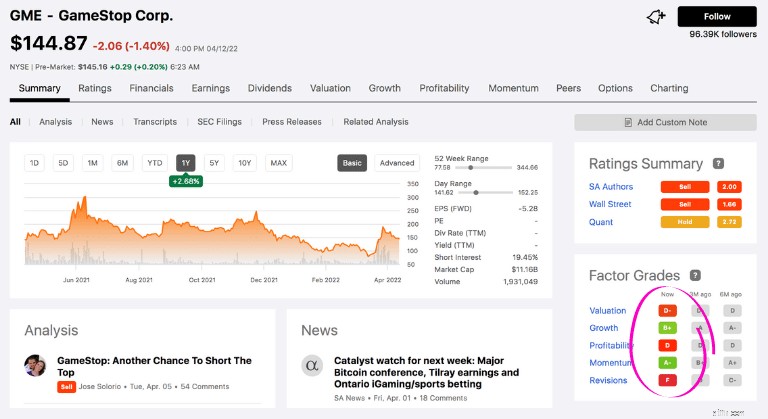
Hộp Điểm yếu tố được chia thành 5 loại mà tôi đã đề cập trước đó.
Điểm của mỗi hạng mục cũng được so sánh với hạng 3 và 6 tháng trước của nó:
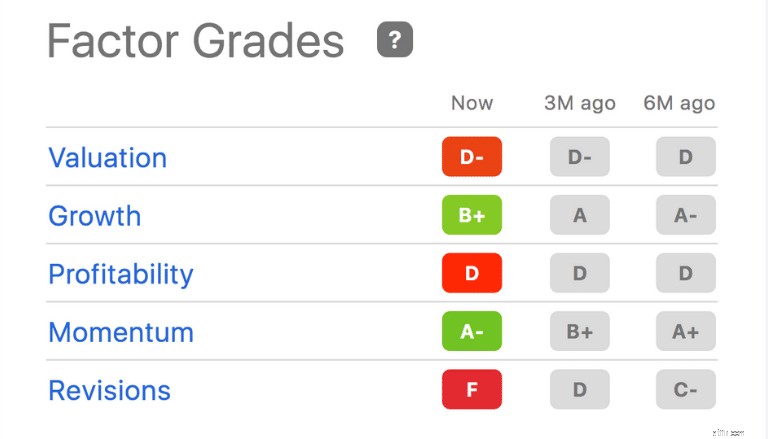
Rõ ràng, Điểm yếu tố dành cho Gamestop khá thấp. Điều này có nghĩa là Gamestop có thể không phải là khoản đầu tư tốt nhất – trừ khi bạn cảm thấy thoải mái chấp nhận rủi ro với một cổ phiếu khá biến động.
Nếu bạn muốn tìm hiểu sâu hơn về từng Hạng Yếu tố riêng lẻ, chỉ cần nhấp vào siêu liên kết màu xanh của từng Hạng.
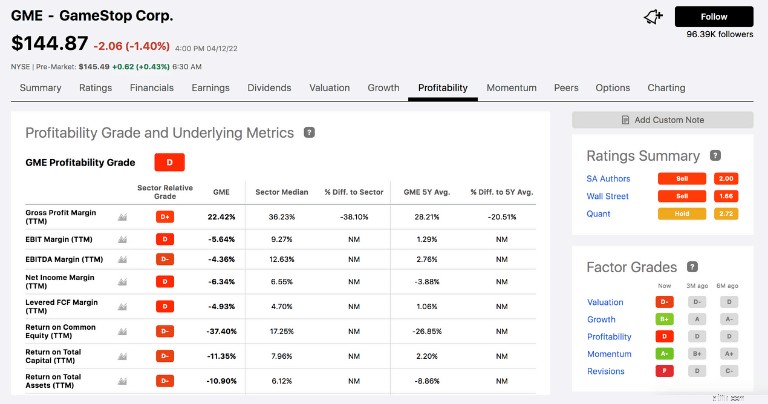
Ví dụ:trong ảnh chụp màn hình ở trên, bạn sẽ thấy một đoạn ngắn về mức độ hiểu biết sâu sắc của bạn chỉ bằng cách đọc về Khả năng sinh lời của Gamestop.
Tôi cũng thích xem tab Động lượng để kiểm tra hiệu suất trong quá khứ và hiệu suất của $GME so với các điểm chuẩn khác – chẳng hạn như S&P 500.
Dưới đây là ảnh chụp nhanh về hiệu suất trước đây của Gamestop so với các công ty khác trong ngành:
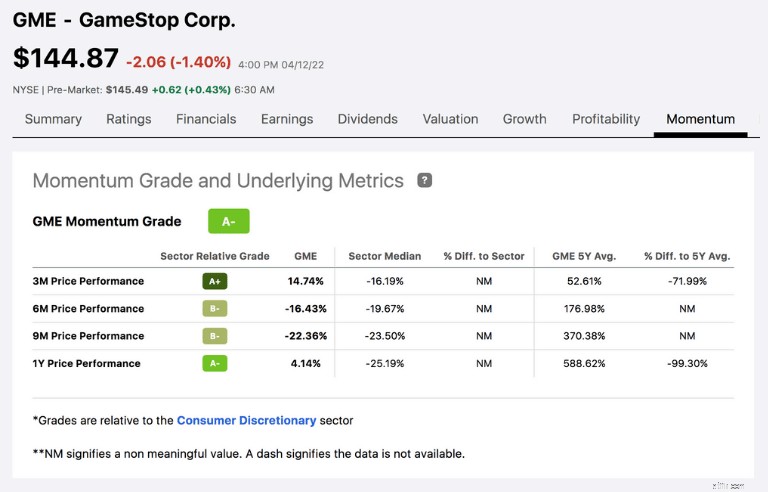
Bạn cũng có thể kiểm tra hiệu suất giá của Gamestop so với các tiêu chuẩn nhất định.
Trong ảnh chụp màn hình bên dưới, S&P 500 được dùng làm điểm chuẩn:
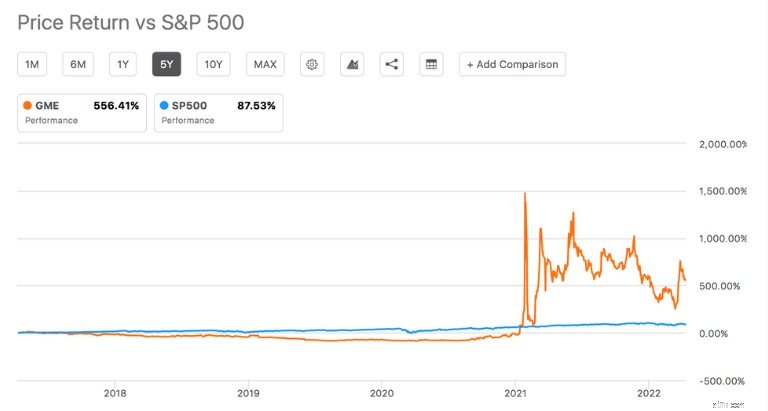
Biểu đồ Hoàn trả Giá này kể toàn bộ câu chuyện:
Bạn có thể thấy Gamestop luôn hoạt động kém hiệu quả như thế nào so với S&P 500 cho đến khi câu chuyện về Gamestop bắt đầu vào đầu năm 2021.
Kể từ đầu năm 2021, giá Gamestop đã tương đối vượt trội so với S&P 500 – nhưng đây có thực sự là một khoản đầu tư vững chắc?
That’s where Seeking Alpha’s tools like the Factor Scorecard can really come into play and help guide you to an answer.
Let’s say you’re thinking about buying Tesla, but you’re not 100% convinced that it’s the right addition to your portfolio.
That’s where the Peer Comparisons come in.
The Peer Comparison tool is customizable, so you can change the stock types that you’re comparing.
Here’s an example:First, search your desired stock (in this case, Tesla):
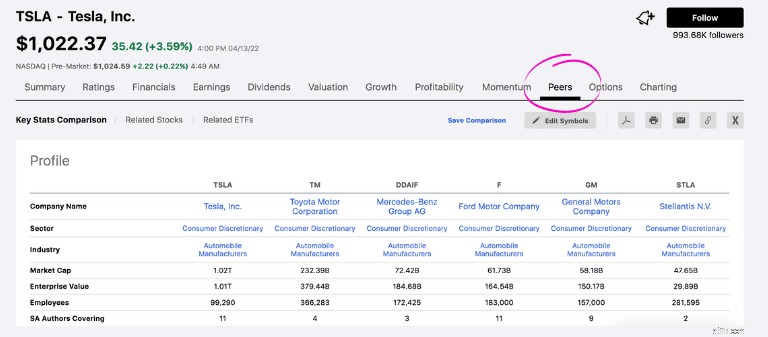
Make sure you click on the “Peers” tab.
Once you’re on the “Peers” tab, you can see that Seeking Alpha already defaults to several peer stocks with which you can compare Tesla.
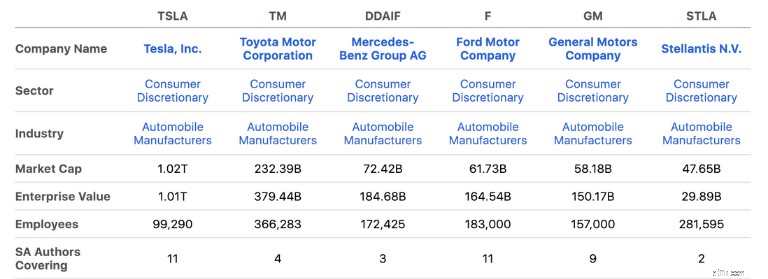
However, if you want to customize the peer comparisons or even reduce the number of peers you’re comparing to, then just click on the “Edit Symbols” button.
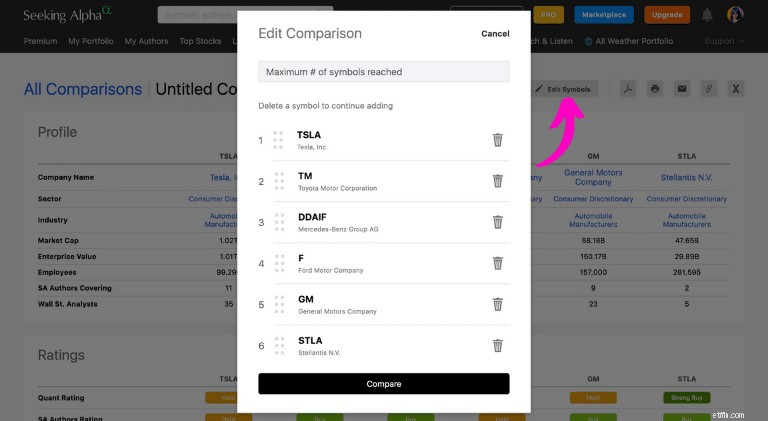
This is where you can customize all peer comparisons.
If you really like a stock and want to receive alerts whenever news about that stock is released, you can customize your own email alerts.
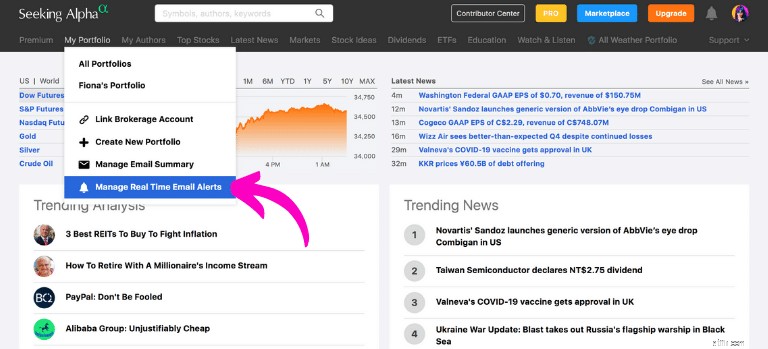
You do this by hovering over the “My Portfolio” tab and then clicking on “Manage Real Time Email Alerts.”
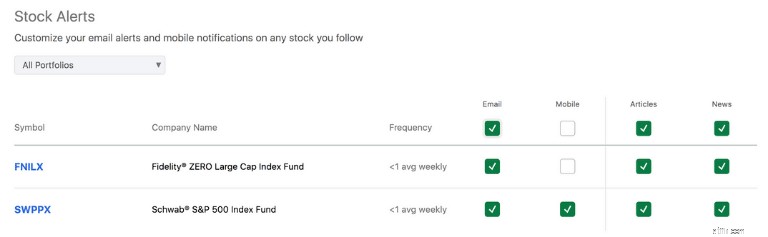
You’ll see a snapshot of your favorite stocks, which you can then select to follow.
The next thing you need to do, is:
I’m a big fan of this alert customization option.
One of the key features when evaluating a stock on Seeking Alpha should be the Quant Ratings section.
Quant Ratings are based on a computer algorithm with the goal to find the best stocks.
As with the previous Ratings (Wall Street and SA Authors), the Quant Ratings compare the stock to other stocks in the same industry.
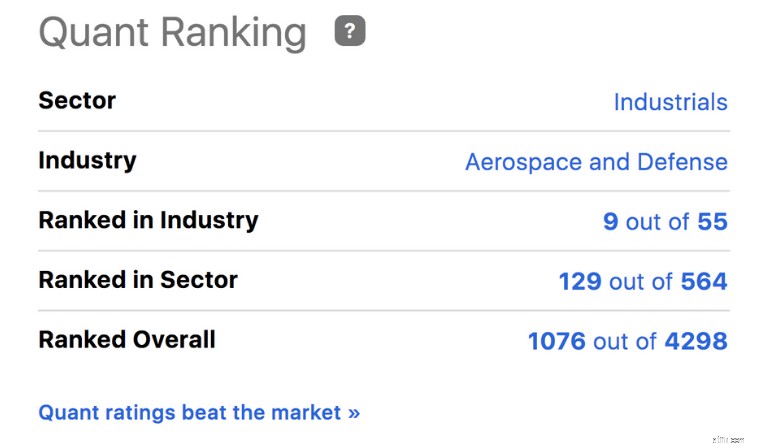
The Quant Rankings use historical information to determine the numbers, as shown in the above screenshot (this case, for Lockheed Martin).
If the Quant Rankings deem a stock to be a top pick, then that stock would be marked as “Strong Buy.”
In Lockheed Martin’s case, the Quant Rankings determined the stock to be a “Hold” for now.
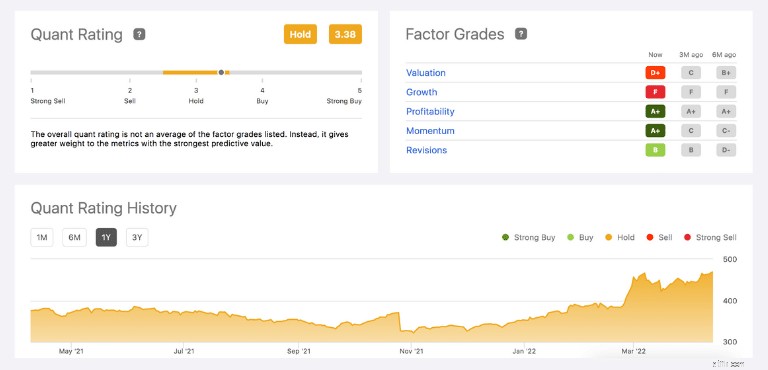
The Quant Ratings and the Factor Grades are both designed and managed by Steve Cress , who has had extensive experience in investment research, hedge funds, and the likes.
The Quant Ratings is what you are looking for – that’s because they can help boost your portfolio performance.
In fact, Seeking Alpha claims that stocks rated as a 4.5 or higher have beat the S&P 500 4x.
On the other hand, stocks rated as 1.5 or lower underperformed the S&P 500, returning roughly 33% of the S&P 500.
Clearly, the Quant Ratings are very helpful.
As you can see, Quant Ratings are a very powerful tool when evaluating the strength of a stock.
But what if you want to view the top-rated stock, using the Quant tools?
Enter the Stock Screener.
You’ll find the Stock Screener by clicking on the “Top Stocks” tab and then clicking on “Top Rated Stocks.”
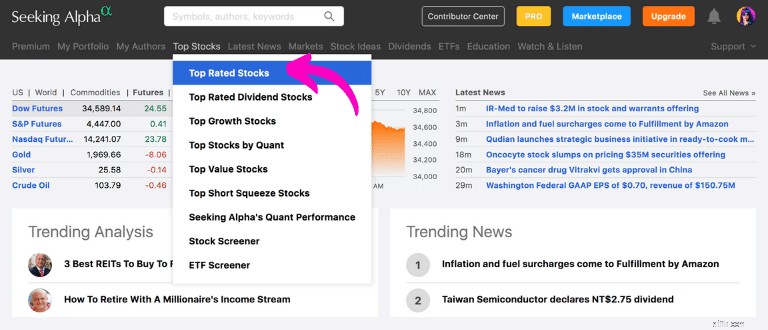
From there, you’ll see a summary of the top rated stocks, and typically the highest Quant Rating is 4.99:
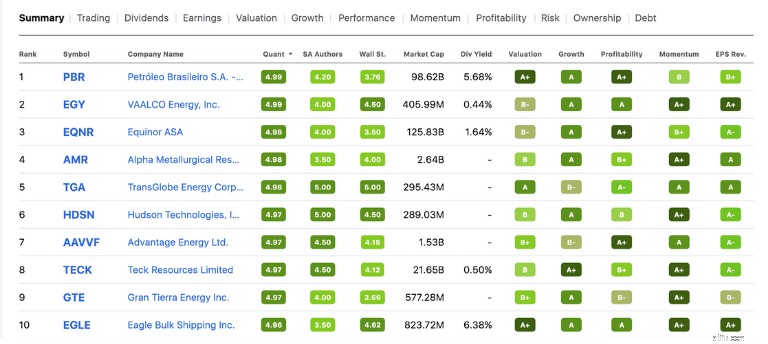
Remember what was said in the previous Quant Ratings section:
Stocks given a Quant Rating of 4.5 or higher have typically outperformed the S&P 500 by up to 4x!
And it’s true that across the board PBR, also known as Petrobas, (in this case the top Quant rated stock) is considered a “Buy” to “Strong Buy” across the board:
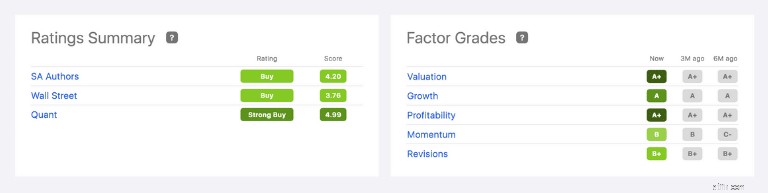
This stock screener is a feature that is currently available to Premium users.
Another neat trick with the Stock Screener?
You can customize your own stocks by using up to 100 different filters!
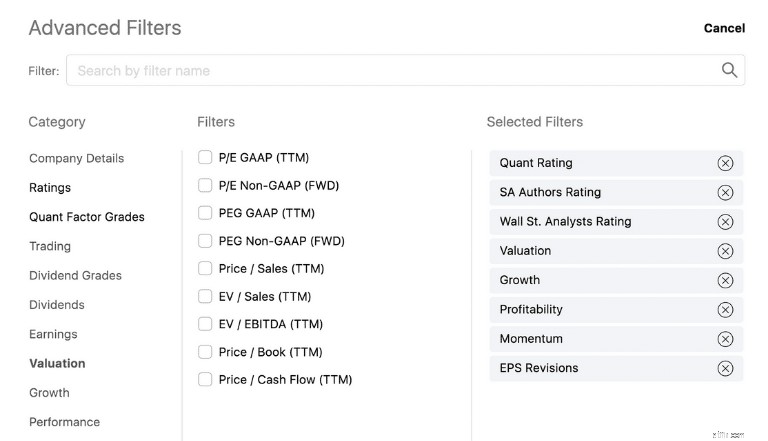
Above is just an example of the many different filter applications you can use to customize your stock screener.
Based on historical performance, stocks ranked as 1.5 or lower drastically underperformed the S&P 500.
If you want to follow what sell-side analysts have to say in terms of buying, holding, or selling a stock, then check out the Wall Street Ratings.
Instead, Seeking Alpha collects data from the Wall Street analysts to determine whether a stock is rated as:
The reason why Wall Street Ratings can be helpful for people like you and me is that these rankings should (in theory) be objective and neutral.
To review the Wall Street Ratings of a certain company, just type in the company name or ticker symbol in the “Search” bar on the top, and then look at the information on the right of the screen.
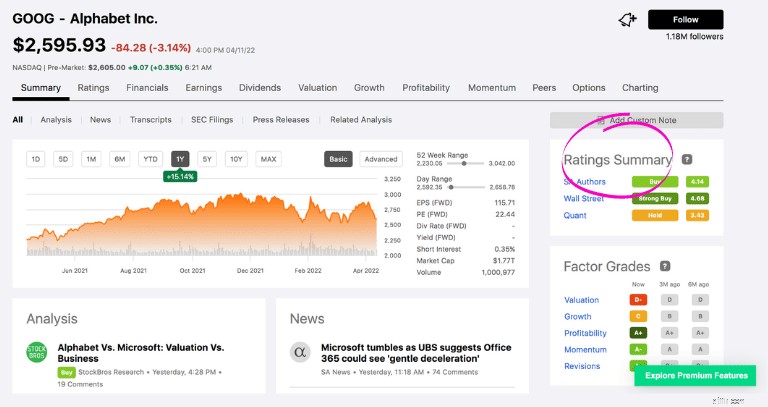
When you look at the right-hand side, you’ll see the “Ratings Summary” outline, with 3 titles:
To learn more about the Wall Street rating, click on the “Wall Street” blue hyperlink.
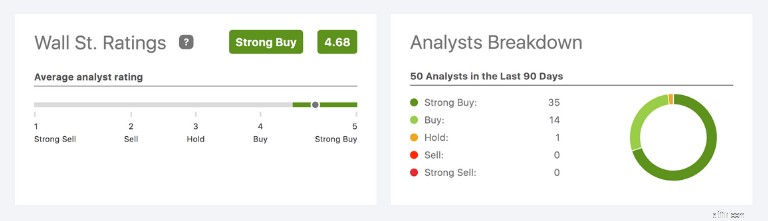
Among other factors, you’ll see the Wall Street average analyst rating and the Analyst Breakdown for each rating.
In Google’s case, 49 out of 50 Wall Street analysts recommended to Buy or Strongly Buy the stock (that’s 98% of analysts!).
Furthermore, you can also review the Wall Street Ratings’ track record for the past few years:
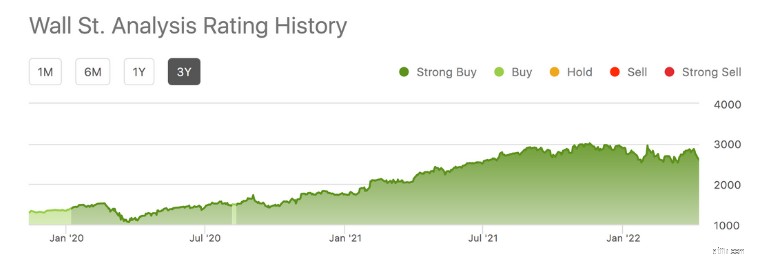
Based on this graph, Wall Street analysts have recommended to Buy or Strongly Buy Google over the past 3 years.
Lastly, you can also see how the Wall Street analysts’ opinions have changed over time with the Recommendations Chart (found at the bottom of the page):
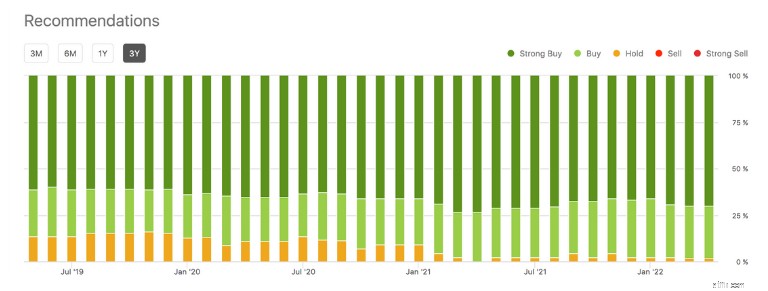
It appears that in 2019 and early 2020 more analysts recommended to hold Google, while starting in 2021, virtually all analysts recommended to buy Google.
Since I’m a very visual person, one of my favorite features on Seeking Alpha is the data visualization of the charts.
In fact, Seeking Alpha has a specific tab named “Charting” that you can access to view the data in an aesthetically pleasing manner:

Once you click on the “Charting” tab, you can even customize the data you want to view.
For example, you can compare one stock’s performance (in the case, Gamestop) to another stock or benchmark like the S&P 500:
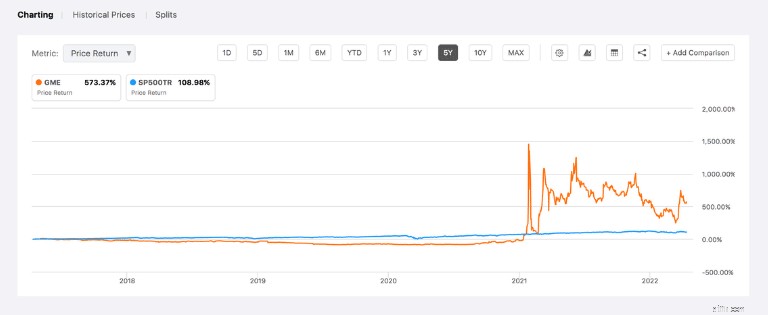
In this custom comparison, you can see that the S&P 500 has typically outperformed Gamestop until early 2021.
If you want to add additional stocks or funds to compare, you can do so, as well:
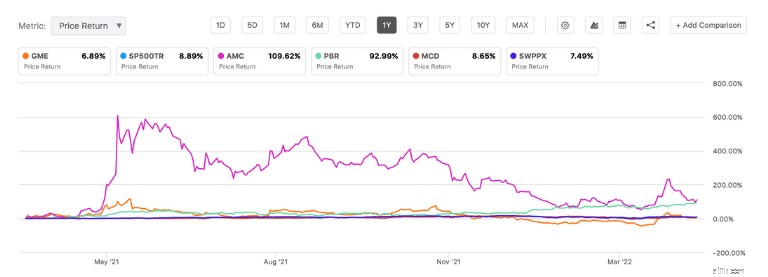
Another neat way to customize your data is changing the format of the data presentation – you can select:

If you’re happy with the data visualization chart you created, you can also copy to clipboard, download, or copy the link to your chart for future reference.
If you’re a Seeking Alpha member, you have exclusive access to earnings calls transcripts.
In most cases, you can expect to have an earnings call at the end of the first 3 quarters.
At the end of the 4th quarter, you’ll receive both an annual report as well as a quarterly report.
If you’re busy at the time of the actual earnings call, you can always count on Seeking Alpha to have a transcript available – both audio and written versions.
You can access the earnings reports of any publicly-traded company by hovering over “Latest News” and then clicking on the “Earnings News” button.
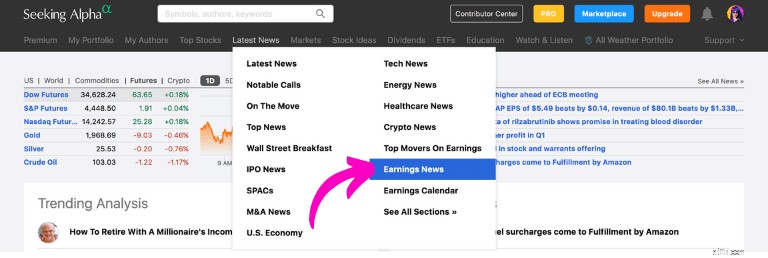
You can also access a schedule of the upcoming earnings calls by clicking on the “Earnings Calendar.”
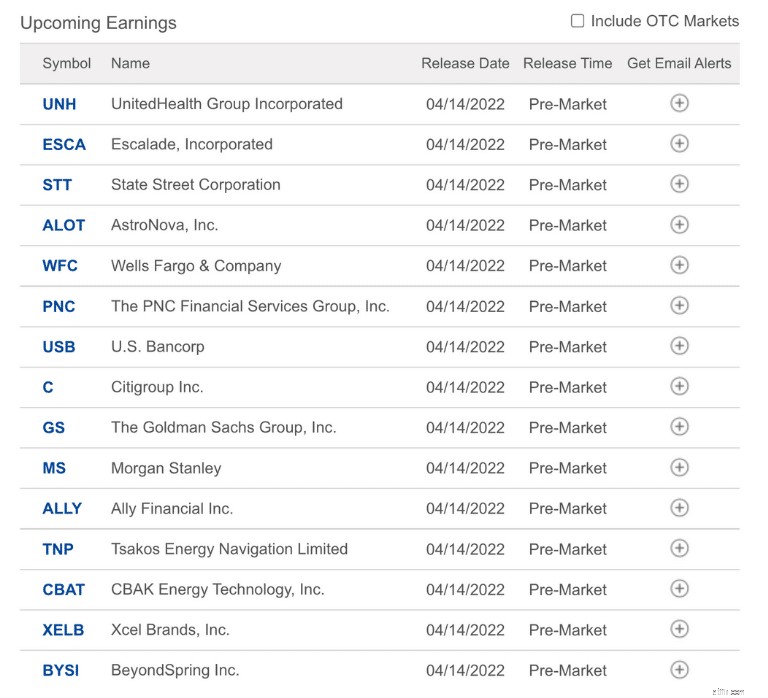
Once in the Upcoming Earnings tab, you can select which company you want to listen to and you can even sign-up for custom email alerts by clicking on the “+” sign.
If you’re looking up one of your favorite companies, let’s call it Amazon, then you just have to click on the “Earnings” tab for that stock:

From there, you can click on the “Transcripts” tab and look at all previous transcripts:
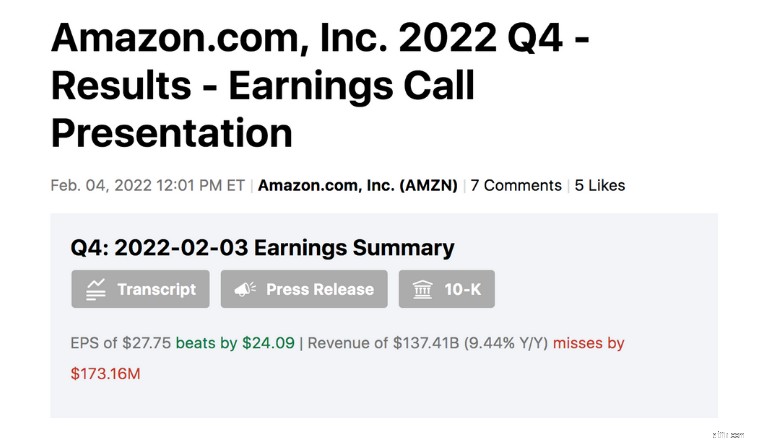
Depending on the company you review, you can also access a PDF file with slides that highlight the company’s key points.
With the Premium (and of course Pro) memberships, you also have unlimited access to exclusive articles written by industry professionals.
Since there is so much information, you can filter out the articles in several different ways.
First, you can simply access your home page and review the “Trending Analysis” of the day or the “Trending News” of the day.
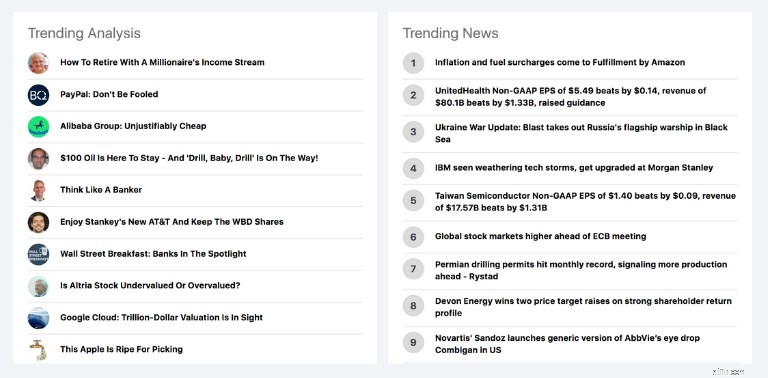
If you want to review articles written by various authors about just 1 particular stock or fund, then just type in the stock name or ticker symbol into the Search Bar.
From there, click on “Summary” and then on “Analysis” so you can see the various articles offered by authors on that stock.
Here’s an example of articles written about the Tesla stock:
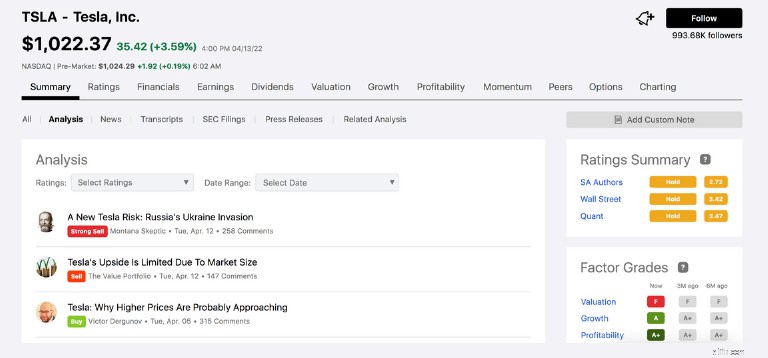
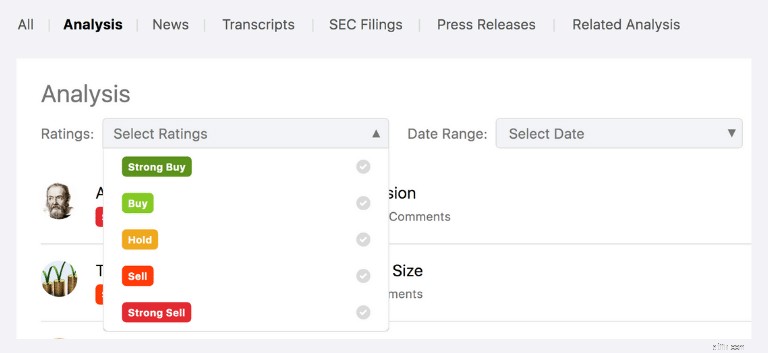
If you want to read articles from authors who advocate buying, selling, or holding, you can customize your ratings by clicking on the “Select Ratings” drop down box.
While most articles do focus on US-based public companies, there are some articles that also focus on alternative investments as well as international companies.
As a Premium Seeking Alpha user, I’m a very big fan of creating your own portfolio in Seeking Alpha.
If you’re dedicated to kickstarting your kids’ financial future, then you may also want to check out the Greenlight Debit Card , which can do wonders.
You can set up your own mock portfolio in Seeking Alpha by hovering over “My Portfolio” and then clicking on “All Portfolios.”
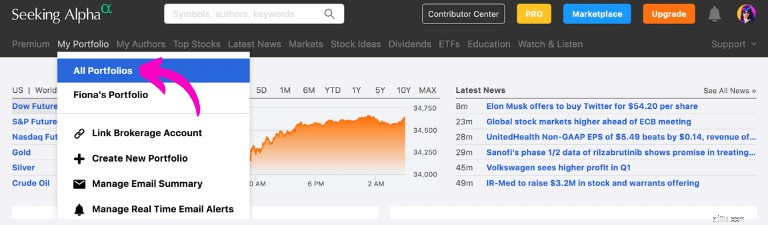
From there, you can click the button titled “+ New Portfolio.”

This will allow you to add a new, mock portfolio while using the Seeking Alpha platform.
You can give that portfolio a title and then you can either link your outside brokerage account to this portfolio or add your own stocks to the portfolio.
For the purpose of this section, we’re going to click on “Create Portfolio.”
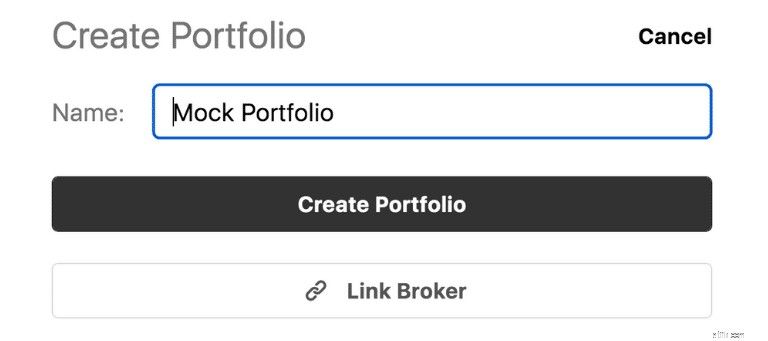
Once you’ve created your portfolio, you can start adding ticker symbols to complete your portfolio.
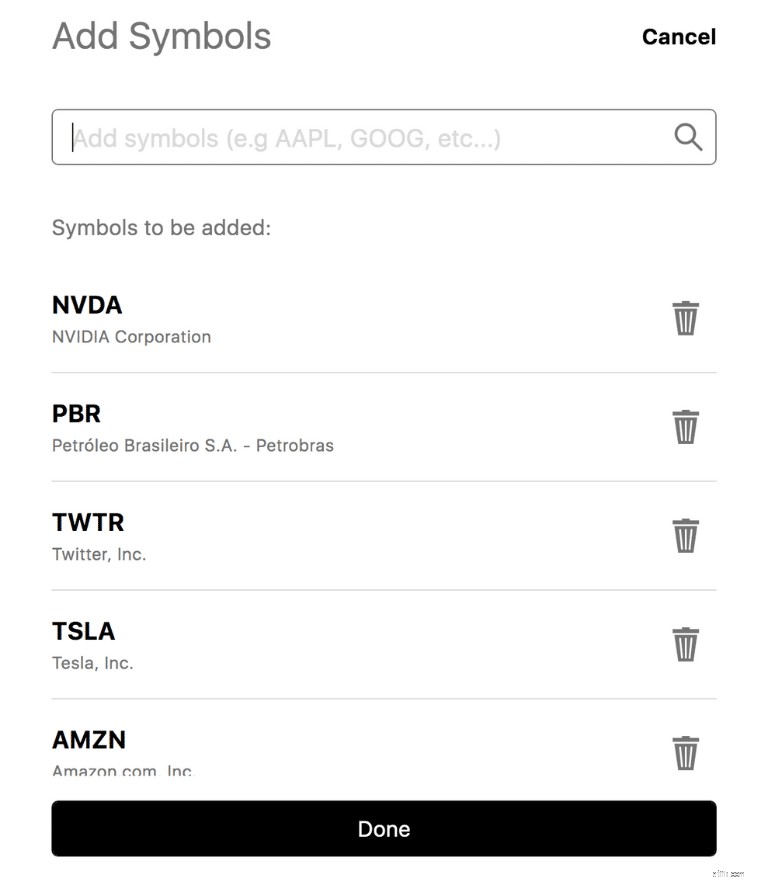
Once you’re happy with your portfolio construction, you can click “Done.”
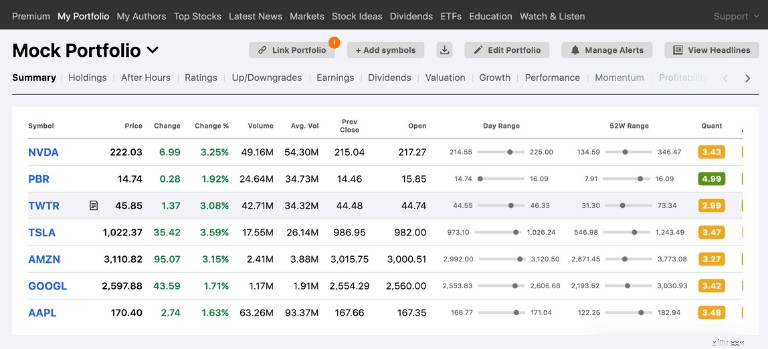
Seeking Alpha does a fantastic job breaking down each stock in your mock portfolio by using multiple different factors.
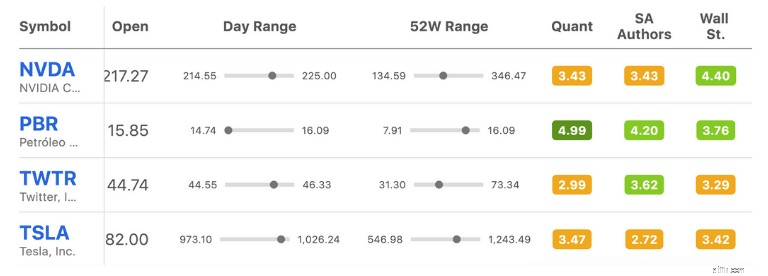
You can even compare the Quant, SA Authors, and Wall Street ratings to each other:
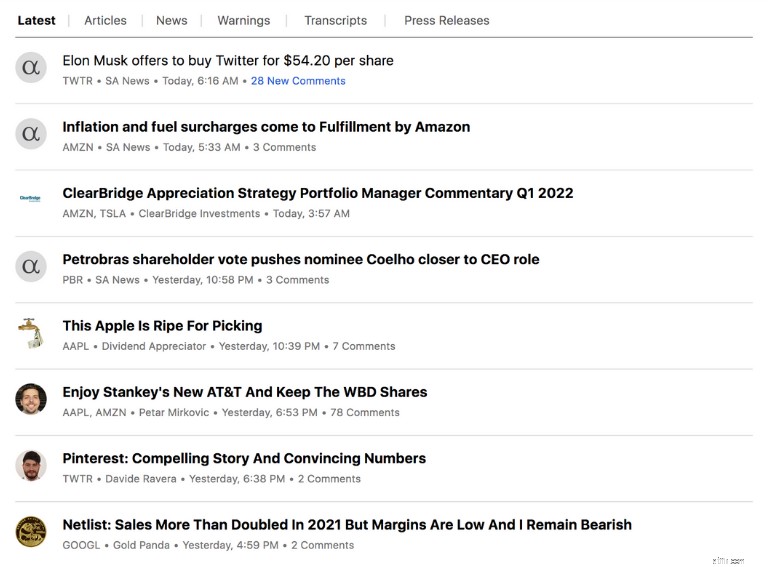
If you click on the “View Headlines” button in your portfolio, you’ll see an assortment of articles written just for your specific stocks in your portfolio:
Finally, one of the other notable features of your Mock Portfolio is the custom alert and notification button.
When you click on “Manage Alerts” you can customize your alerts based on:
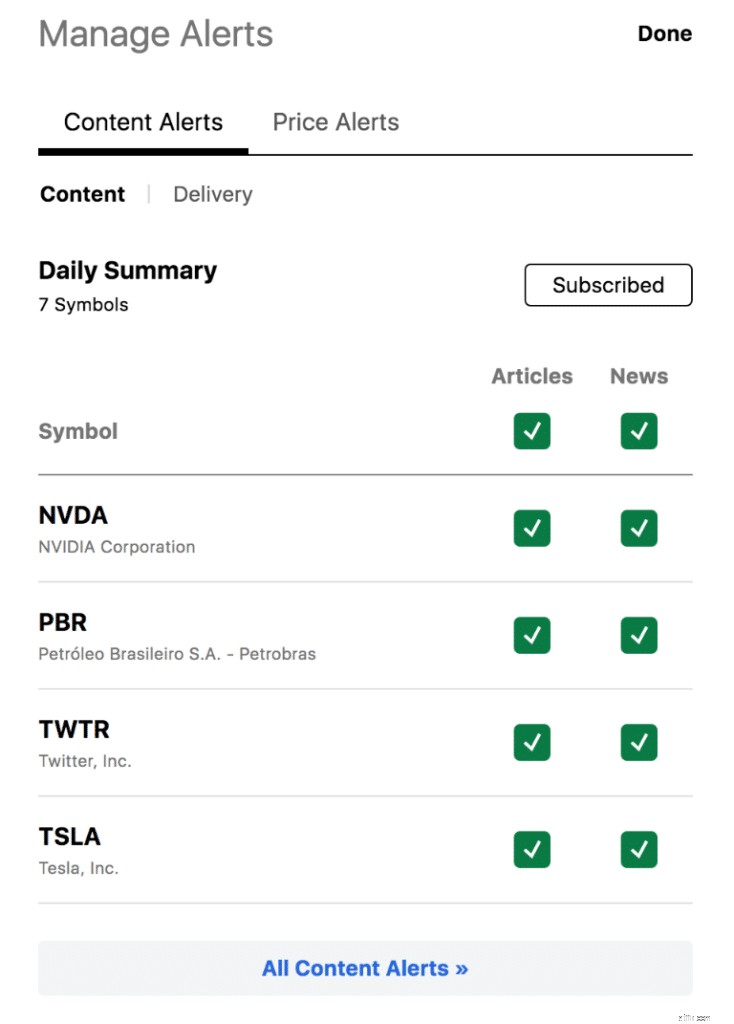
So, if there is an update on a stock like Twitter for example, you’ll receive real-life notifications to your email or phone – depending on the delivery method that you select.
You can also manage your price alerts, which I will review in a separate section here.
If you’ve already created your mock portfolio through Seeking Alpha (or even if you’ve already connected your outside brokerage account with Seeking Alpha), you can set custom price alerts.
For example, if you own shares of Twitter and the current price Quant Rating is 2.99, which is nearing a sell territory, then you may want to filter for other stocks that might be deemed a “Strong Buy.”
Here’s how (this is assuming you’ve already set up your own portfolio in Seeking Alpha. If not, then please reference the previous feature):
First, access your portfolio and click on “Manage Alerts.”
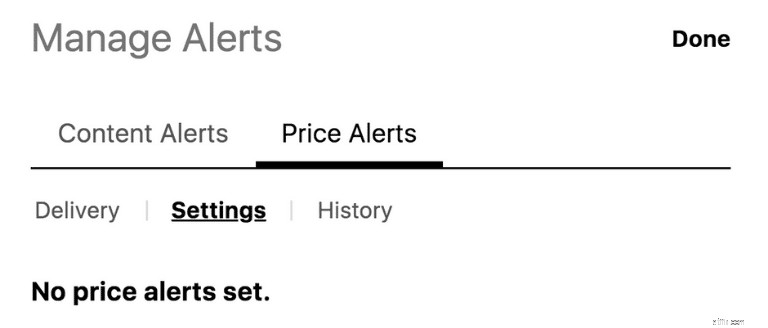
Then, click on “Price Alerts” and then on “Settings.”
From there, you’ll want to click on “All Price Alerts,” which you’ll find at the bottom of the dialogue box.
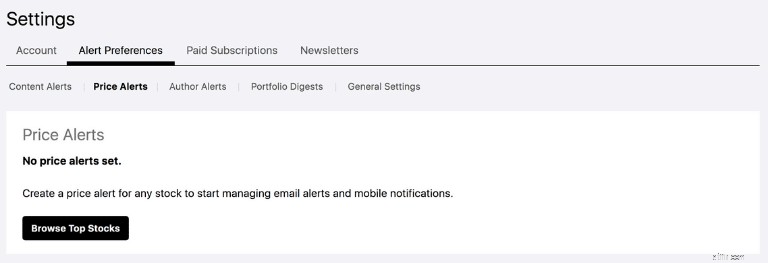
From there, click on the “Browse Top Stocks” button.
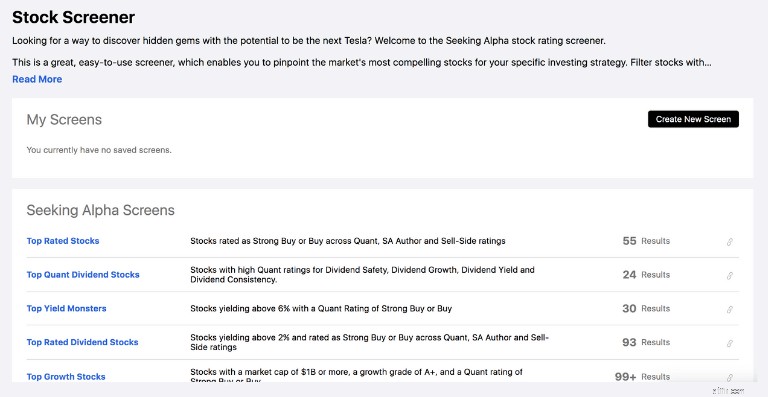
You can either continue using the Seeking Alpha Screens (and there are many) or you can create your own, custom screen.
If you create your own custom screen, you’ll be brought to a window like the one below:
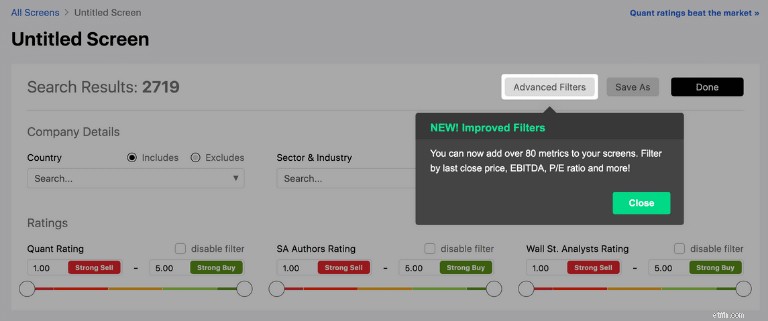
You can customize your stock screener by adding up to 80 different filters.
For example, if you want to screen for all stocks that are assigned a 4.00 out of 5.00 rating for the Quant, SA Authors, and Wall St. Analysts, this is the place to do so.
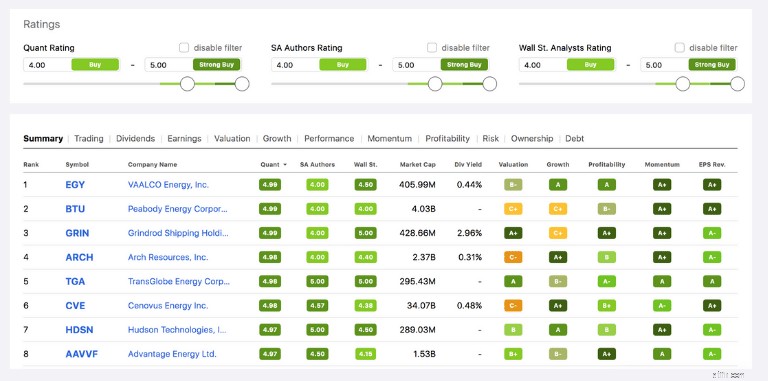
Take some time to experiment with the screening tool, because there is just so much information.
However, if you’re ever wondering why or how to filter for the best stocks for your portfolio (or your child’s portfolio), this is probably the tool you’ll want to use.
If you’re an investor who really enjoys digging deep into the financials for each company before trading its stock, you’ll be happy to know that the Premium tier also comes with downloadable financial statements .
In fact, you can access up to 10 years worth of financial statements to download, review, and analyze.
Just search your favorite company and click on the “Financials” tab.
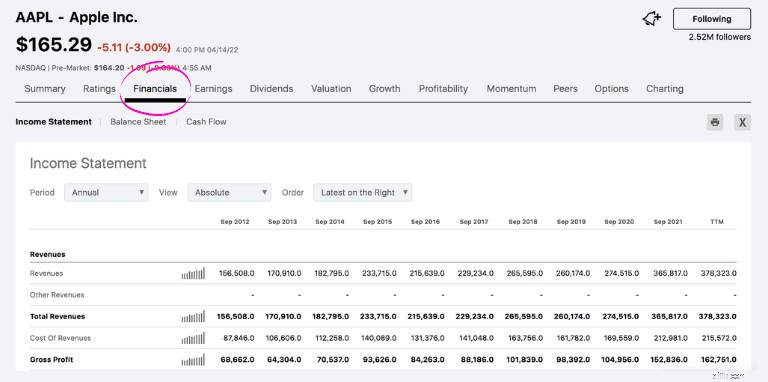
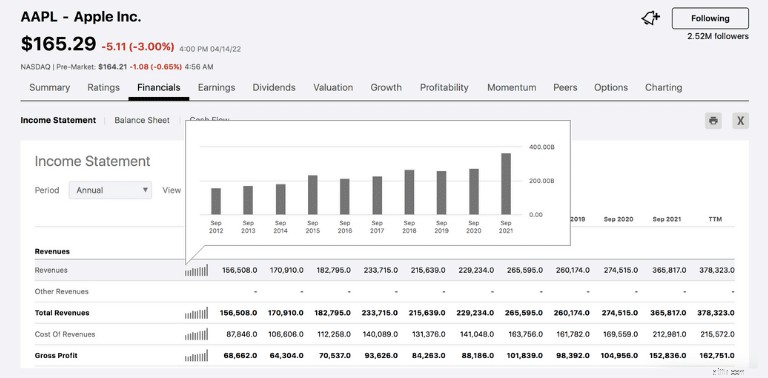
From there, you can either review the numbers or for a more visual approach, just hover over the line graph for each data set:
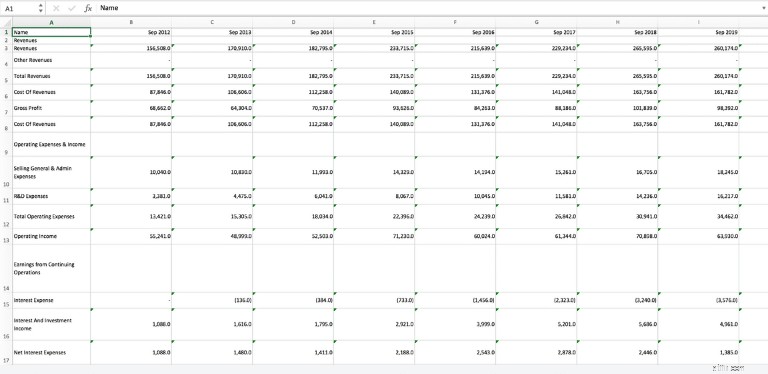
If you want to review the numbers in even more depth, you can click on the print icon or the “X” icon at the top, right of your screen to either print to PDF or download via Excel.
So depending on how in-depth you want to go, Seeking Alpha really gives you a lot of options to analyze your stocks.
Ever wonder how your current stocks compare to other stocks in the marketplace?
Take a look at the Stock Performance Comparison Tool – which is one of my favorite tools.
Just search your favorite stock and then click on the “Charting” tab.
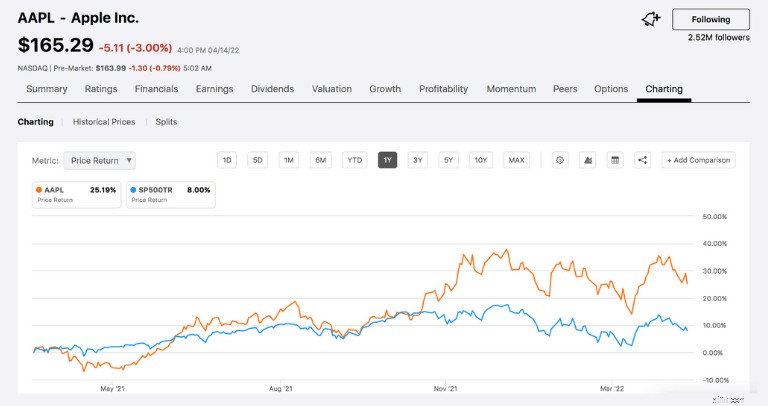
The default comparison is your stock (in this case, Apple) and the S&P 500.
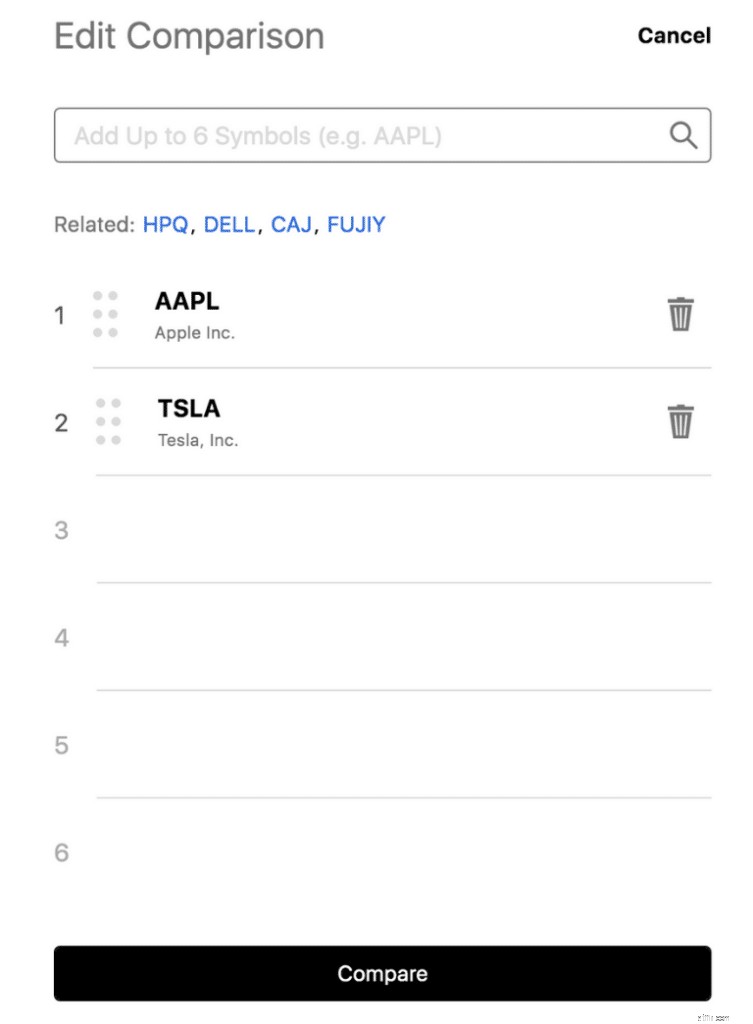
However, if you want to know how apple is doing compared to another individual stock in the tech or a similar sector (like Tesla), then just click on the “+ Add Comparison” button and add your favorite stock:
Now take a look at the comparison of Apple stock versus Tesla stock over the past 3 years:
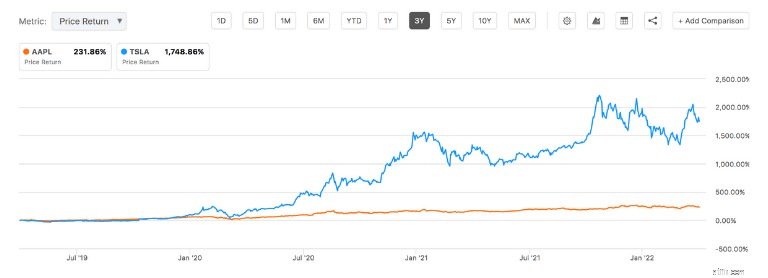
While this stock performance comparison chart shouldn’t be the only tool you should use to determine whether a stock is worth a purchase, it can certainly be a helpful guide.
Lastly – but certainly not least – another cool feature with the Premium Tier is that you can link your outside investment accounts to your Seeking Alpha account.
Remember that you’ll receive access to Seeking Alpha’s quant comparison tool, the Wall St. Analyst ratings, and the SA Author rankings – along with customizing real-life alerts for each of the stocks you hold.
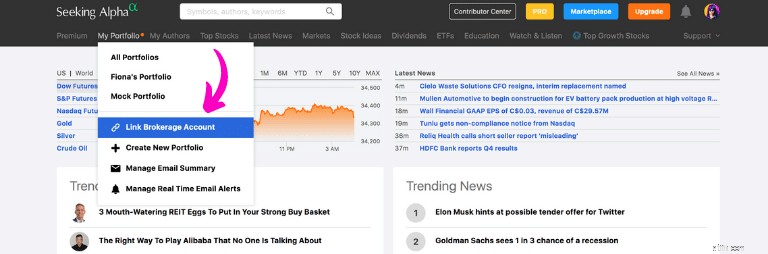
To start linking your outside accounts, just navigate to your main menu, hover over “My Portfolio” and then click on “Link Brokerage Account.”
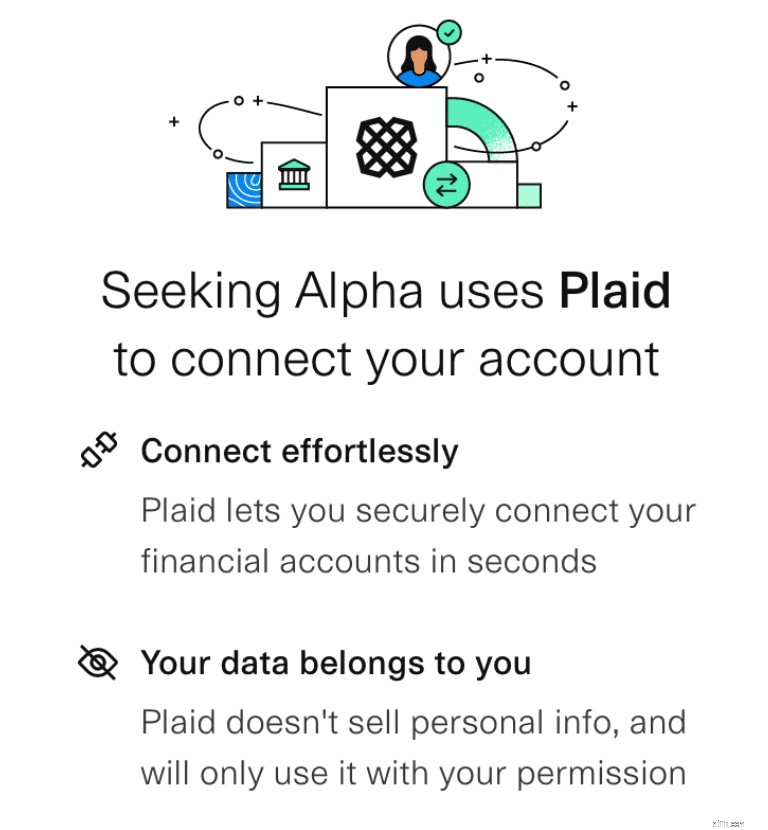
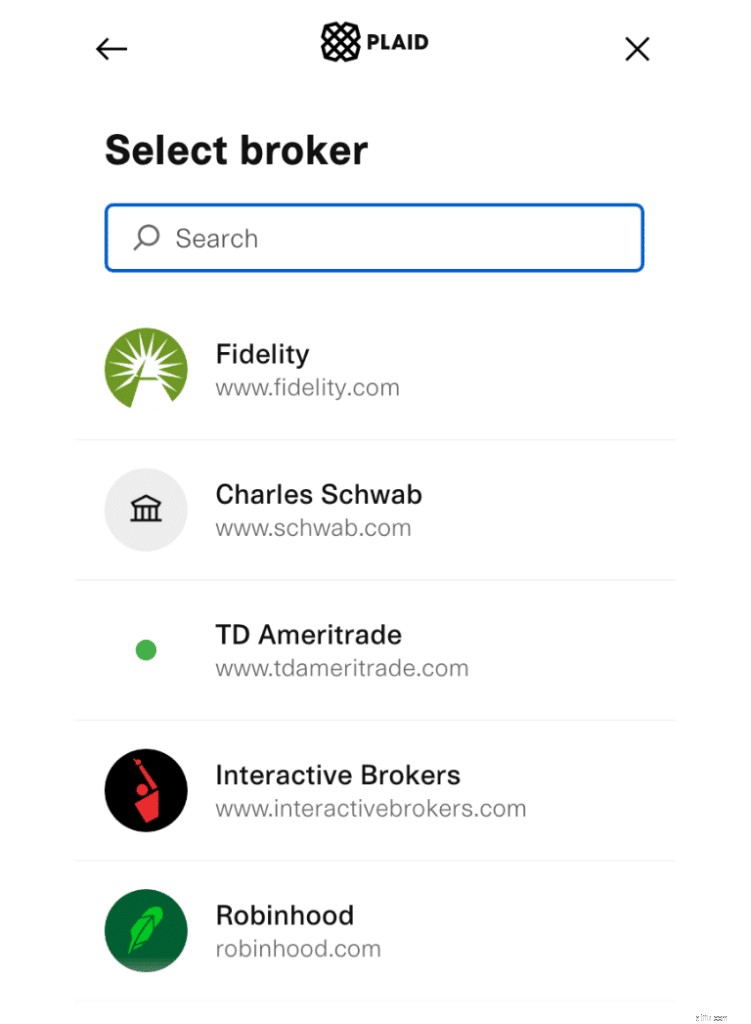
Any outside brokerage accounts that you link will be connected using the secured encryption software, known as Plaid.
You can select a number of different brokers, such as:
Even if you don’t see your brokerage firm immediately, you can either search for your brokerage firm or sometimes even input the information manually.
Once you’ve established a link to your brokerage account, you can do the following:
Keep in mind that Seeking Alpha is an informational platform only – you cannot place investment trades on Seeking Alpha.
So to buy or sell stocks in your linked brokerage account, you’ll actually have to sign in to your own investment account.
Recommended Reading:Best Investment Apps
Seeking Alpha Premium could be right for you if you:
Being a Premium Plan member myself, my favorite part is that you can use the Premium tier for as much or as little research as you want.
For example, if you’re thinking about adding Build-A-Bear Workshop, Inc. (BBW) to your portfolio, and you want some additional advice from industry experts.
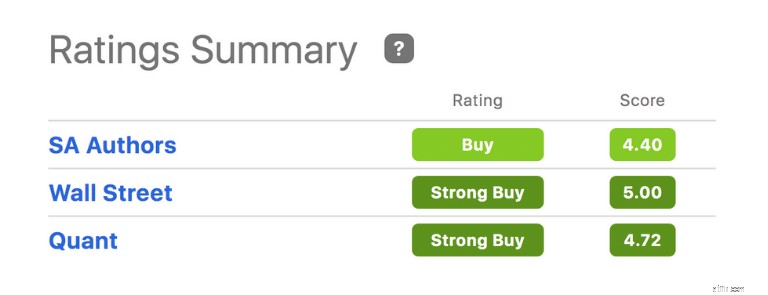
In this case, just check out the BBW stock rankings in the Ratings Summary section.
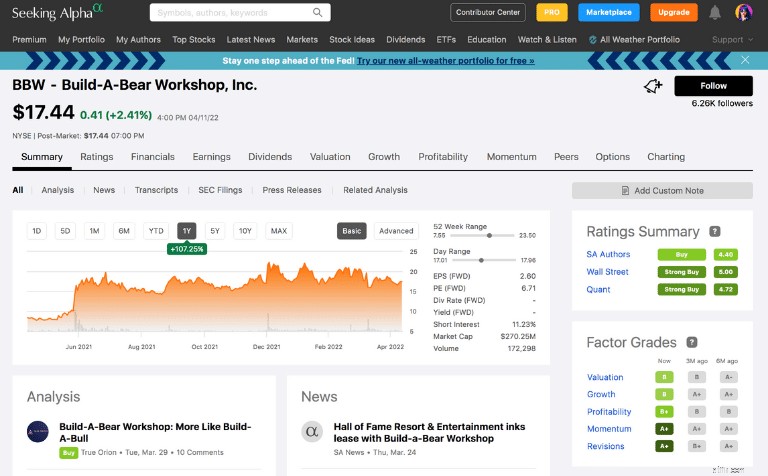
You’ll see that on 3 different instances, the BBW stock is considered a Buy to a Strong Buy opportunity:
Now, if that’s all the reassurance you were looking for, you can move on and not look back.
However, if you want to drill into more depth with the Build-A-Bear Workshop, Inc. stock, Seeking Alpha lets you do as much fundamental analysis as you want.

The Bottom Line:
The Premium Plan gives intermediate investors the best of both worlds:Reassurance on which stocks to buy, hold, or sell while also going into as much analytical depth as possible.
Just like the Premium Plan, you can also start a 14-day free trial period with the Seeking Alpha Pro Plan .
If you enjoyed the Pro Plan trial period, then you can pay for the Pro Plan in 2 ways:
Monthly Plan
$299.99/month
Annual Plan
$2,400 (or $199.99/month, as advertised)
It appears that the default case for Seeking Alpha is charging the full year’s worth of premiums upfront (so $2,400 in this case).
One of the best benefits to the Pro Plan is that you receive VIP access and Editorial Concierge, customized to your needs.
Keep reading to find out more about the key features of the Pro Plan.
In this section, I’ll explain in detail some of the top Pro Plan features and how you can benefit from each (keep in mind that the Pro Plan already comes with the Premium Plan features).
Below is an overview of the additional Seeking Alpha Pro Plan features:
With the Seeking Alpha Pro Plan, your entire user experience will be ad-free.
Remember that the Limited Access version does come with ads and the Premium version offers an ad-lite user experience.
The Seeking Alpha Pro platform gives you the chance to be as specific as possible when filtering your investments.
You can filter your investments by:
If you know what you’re doing and if you know what you’re looking for, then this investment screener can be used to your advantage.
If you want the bells, the whistles, and the exclusive VIP treatment, then you should consider the Pro Plan.
The editorial team works directly with Pro level subscribers to filter out and pinpoint ideas that fit to your investing needs, style, and preferences.
If you want daily short summaries of the top 1% of the Seeking Alpha content, then your Seeking Alpha Pro level subscription will give you that VIP treatment.
As a Pro member, you’ll have Seeking Alpha’s industry experts send you a weekly list of their hand-picked top investment ideas from Seeking Alpha contributors.
Seeking Alpha Pro could be right for you if you:
Another neat feature is that you could also contribute to the Seeking Alpha community by writing an article with your research and opinion.
The Bottom Line:
The Pro Plan gives advanced investors and industry professionals an in-depth and resourceful experience when researching and analyzing stocks, funds, and ETFs.
I’ve personally reached out to Seeking Alpha’s customer service on 3 different occasions to evaluate their:
…And I must say that Seeking Alpha passed my test with flying colors.
Below is my evaluation:
Knowledge
⭐️⭐️⭐️⭐️⭐️
Friendliness
⭐️⭐️⭐️⭐️⭐️
Kinh nghiệm
⭐️⭐️⭐️⭐️⭐️
I’m drawing from my own personal experience from speaking with 3 different Seeking Alpha personal representatives.
The good news is that you can contact Seeking Alpha in 4 main ways:
contactus@seekingalpha.com
Social Media
– YouTube
Navigation Bar
Support Button
Phone Call
347-509-6837
Phone Support Center Hours
Monday to Friday 8am to 4pm EST (holiday hours may apply)
It’s reassuring for me to see the different ways you can contact Seeking Alpha.
While Seeking Alpha is not accredited with the BBB, I was still shocked to see the “F” rating on the BBB website:
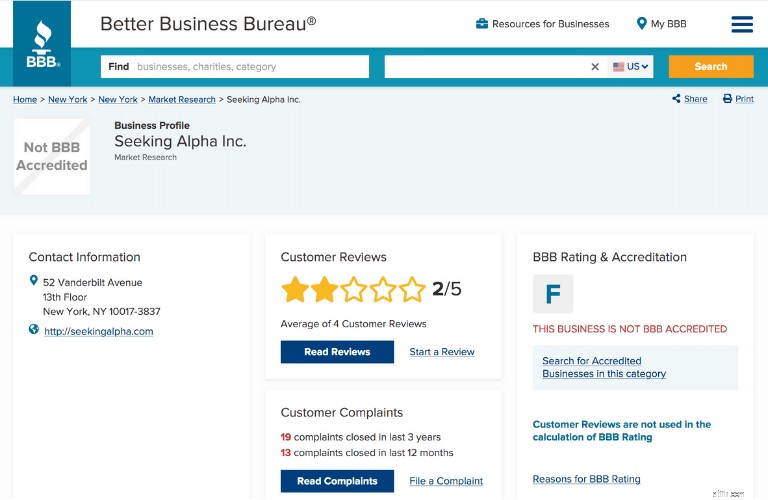
I even double-checked to see if I had the right Seeking Alpha company pulled up on my screen – and I did.
The common complaints appear to only apply to subscribers looking for the “free trial” period:
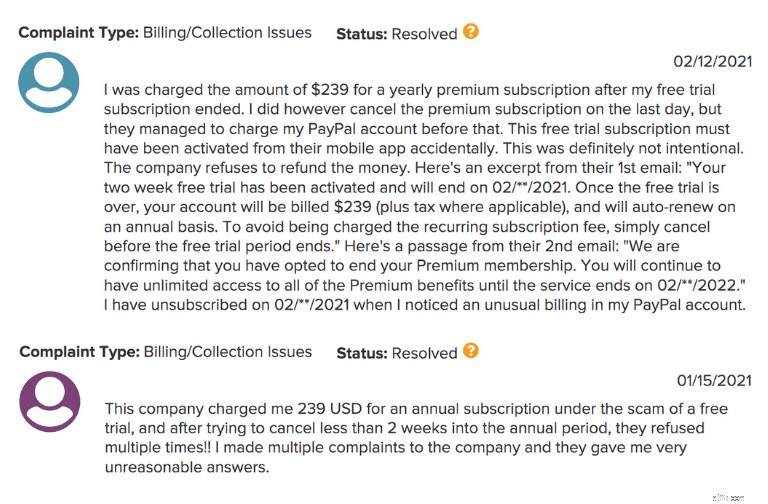
Based on these complaints (which are somewhat recent), it looks like many customers who signed up with the free trial period were charged after the period ended.
Based on this information, if I were signing up to the free trial period, I would probably triple check to read all of the fine print and possibly even cancel before the trial period is over (assuming you’re not happy with the platform).
Now that you have an idea of what people are unhappy about, let’s take a closer look at the ratings on TrustPilot, which is another customer review website.
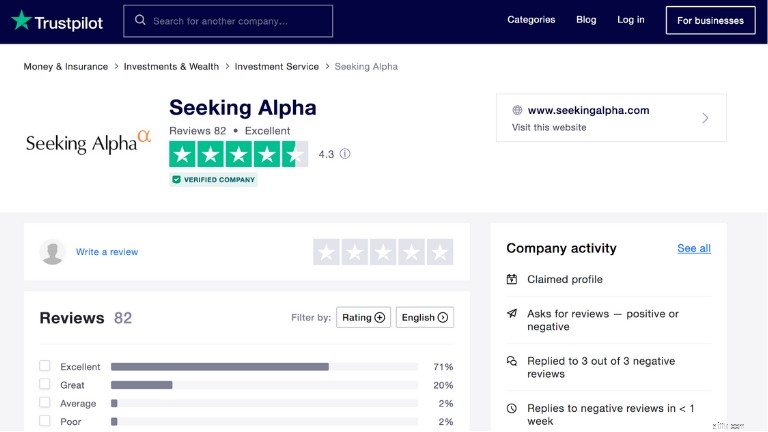
Now, this Trust Pilot customer review is more in line with what I was expecting to see.
On TrustPilot, a solid 93% of respondents rated Seeking Alpha average to excellent.
Some reviews are below:
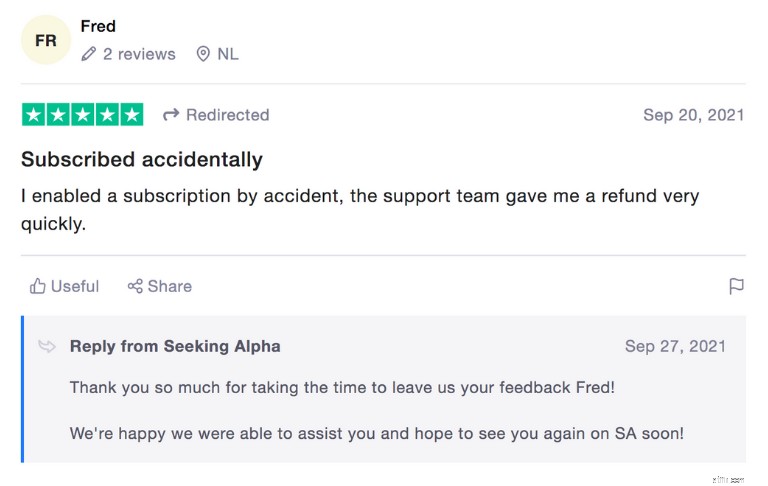
This review virtually contradicts the reviews from the BBB, which said Seeking Alpha did not offer a refund.
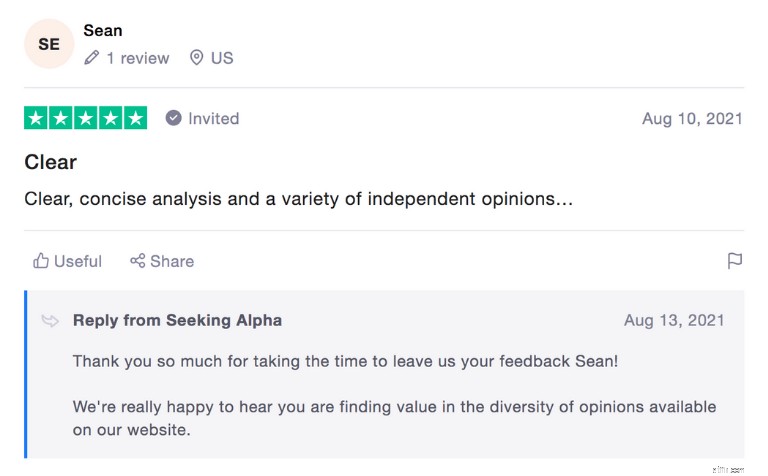
Above is another positive review about the accuracy and impartiality (no bias) of the authors that provide information on Seeking Alpha.
Of the 2 negative reviews that were posted from the 82 total reviews, the complaints were the following:
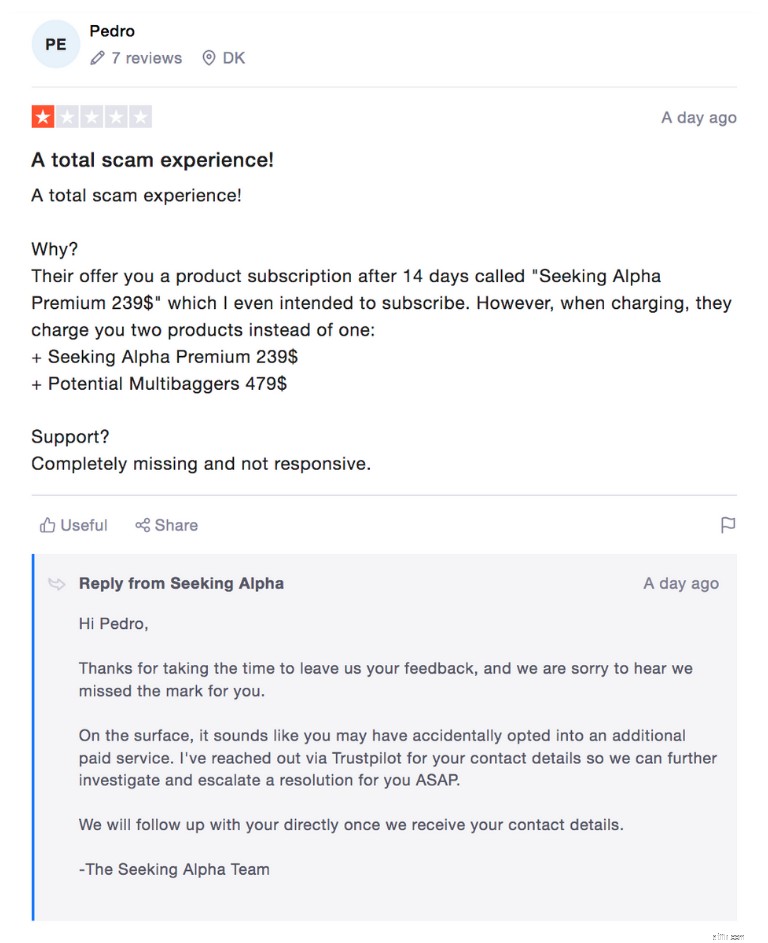
Take a look at the response time of when the negative review was posted (1 day ago) versus the reply from Seeking Alpha (also 1 day ago).
I thought that was impressive.
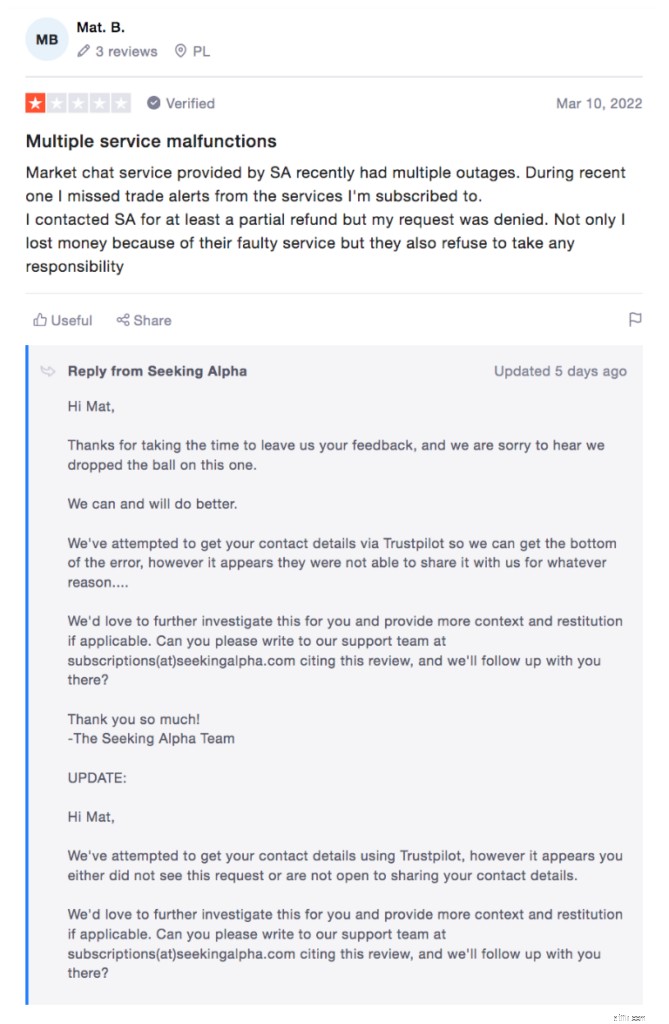
As you can see, there will always be good and bad reviews, and you’ll have to take the reviews with a grain of salt (seriously).
Personally, I like checking back into the customer service review platforms every few months, just to read updates.
The Bottom Line:
Most of the “Bad” Seeking Alpha reviews involve the free subscription service. According to the complaints, immediately after the free trial period ends, the consumer credit card will be charged the annual amount for a paid subscription (likely the Premium subscription).
Now it might sound daunting that Seeking Alpha offers works from 7,000 active monthly authors.
You might even be concerned about the quality of the information if there are so many contributors.
Their team has a pretty quick article turnaround time as well, which typically ranges between 1 hour to a few business days.
Do you have industry expertise and want to contribute?
Below are 9 of the most important requirements to pass the rigorous Seeking Alpha editorial review process:
Market-Oriented
Write about stocks, sectors, ETFs, or other actionable themes for US-based investors
High-Quality
Articles must be convincing, well-presented, and actionable
Fundamental Analysis
Articles must address factors such as a company’s competitors, products, management, corporate strategy, etc.
Originality
Always bring a new perspective to a topic
Compelling Title
Your title shouldn’t overpromise and underdeliver
Market Cap
Articles mentioning stocks trading at less than $1 or companies with market caps less than $100 million will receive extra scrutiny
Clean
You must proofread your article before submission
No Promotional Content
No promotional content in articles
Human Factor
Editors work closely with contributors and maintain a constructive dialogue
As you can see, there are a lot of requirements that go into the making and the publication of a Seeking Alpha article, so chances are that you’ll get the high quality you want.
And with each month, over 10,000 articles are published on Seeking Alpha!
Another neat thing is that you can view a contributor’s past track record of stock predictions.
Another trick to finding information from top ranked authors is just simply clicking on the “Top Authors” button.
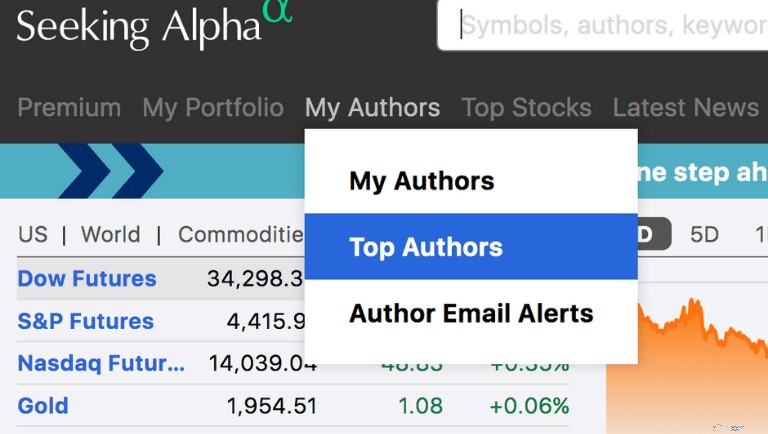
Once in the Top Authors section, you’ll receive a long list of author suggestions, based on their specialty (such as value investing, growth investing, oil &gas investing, etc.).
Another reason why I’m a big fan of Seeking Alpha is because of the abundance of educational resources this platform offers its users:
Investment Videos
Access top investment news videos by clicking on the tab “Watch &Listen” and then clicking on “Videos”
Investment Podcasts
Learn more about the latest investment news by accessing 8 Seeking Alpha podcasts. Click on “Watch &Listen” and then on “Podcasts”
Financial Planning Education
Seeking Alpha knows that investing is just a part of the financial planning process. When you click on the “Education” tab, you’ll gain access to a variety of different financial planning topics, ranging from cryptocurrency to 401(k) management
Seeking Alpha Knowledge Base
Type any question into the search box and you’ll probably find an answer. The Knowledge Base can be accessed by clicking on the “Support” icon and then “Knowledge Base”
Feedback Forum
If you ever have trouble with the Seeking Alpha desktop website or the mobile app, this is the place to share your concerns, feedback, and interact with other users. Access the forum by clicking on the “Support” icon and then “Feedback Forum”
As you can see, Seeking Alpha does not keep you in the dark – when it comes to investing or financial planning-related matters.
One of my favorite learning sections on Seeking Alpha is the “Education” section, where Seeking Alpha users can learn about more than just investing.
Under the education tab, you access articles about other topics that may not be covered in-depth by the Seeking Alpha Authors.
Some of these topics include:
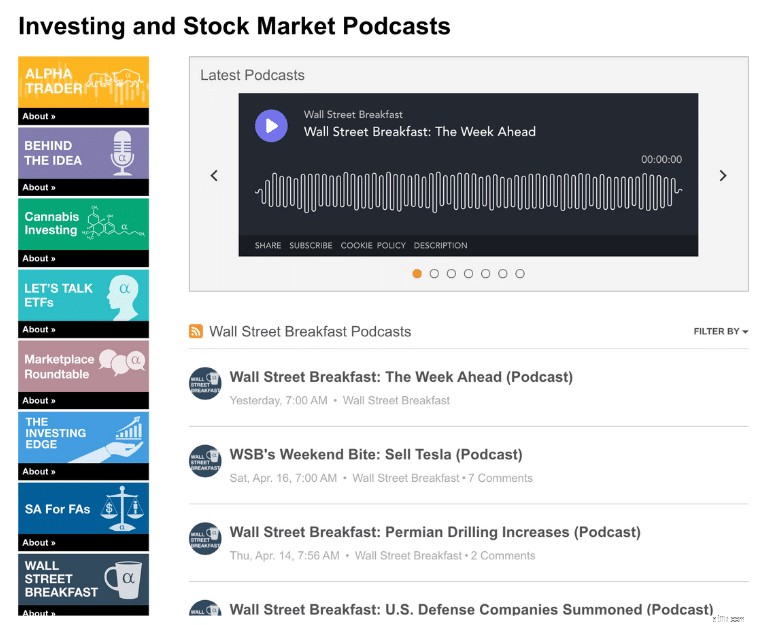
I’m also a fan of the “Watch &Listen” section, which offers Seeking Alpha readers access to investment podcasts and videos.
If I’m ever stuck in traffic, I listen to one of the podcasts (I like the Wall Street Breakfast podcast).
The good news is that Seeking Alpha offers so much variety from which to choose – you’ll never be left without ideas.
Ready to open an account with Seeking Alpha?
Believe it or not, it’s actually a very fast and simple process.
First, head to the Seeking Alpha website and click “Subscribe.”
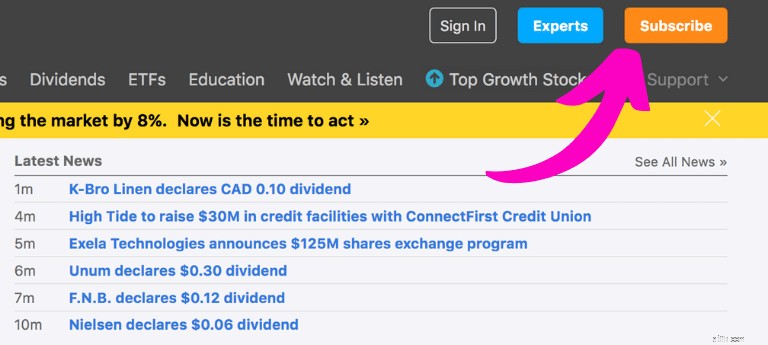
After you click the subscribe button, you can choose to either start a free trial or register immediately with one of the 3 plans (Limited Access, Premium, or Pro).
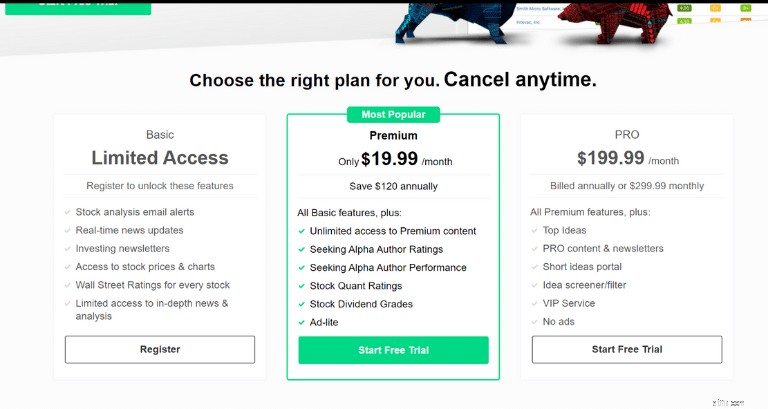
Now, if you’re ready to register and pay for your subscription, then select your plan preference.
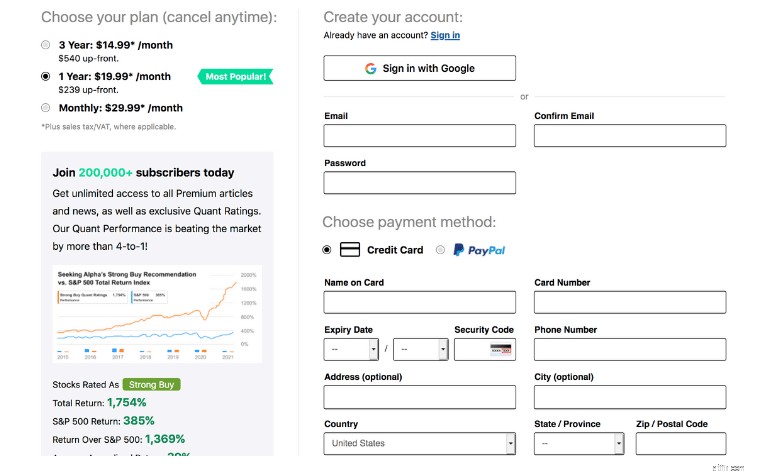
Payment methods are either via credit card or PayPal.
In my opinion, if you’re an investor who really wants to understand more about your investment holdings, then Seeking Alpha is probably a great platform for you.
Yes, Seeking Alpha is worth the cost if you do your own investment research and want to interact with experienced investors. For $19.99 per month, you get access to exclusive content from over 7,000 experienced investment authors, custom stock performance charts, and portfolio monitoring tools.
If you sign up to the Premium Platform, you can access the Seeking Alpha Quant Ratings, which have outperformed the market since 2010.
The Quant Ratings marked as “Very Bullish” for stocks were up 1,754% versus the market’s 385% gain.
On the other hand, the stocks that were rated as “Very Bearish” by Seeking Alpha really did underperform, being up by only 156% versus the market’s overall 385%.
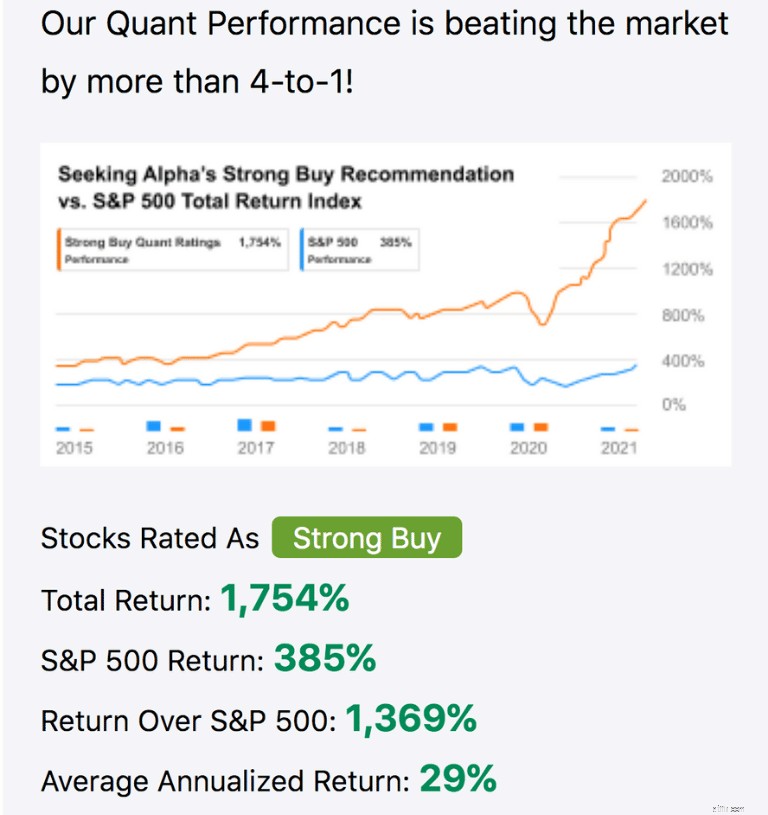
While I’m not a fan of day trading and stock picking, if I am looking to buy or sell a stock or fund in my portfolio, Seeing Alpha would be my first stop before hitting that “trade” button.
Seeking Alpha might not be for everyone.
If you’re an active investor and just don’t like the investment research platform, then you may want to check out platforms like the Motley Fool’s Stock Advisor.
While the cost is certainly lower for new members ($99 per year), you also don’t get access to the customization, the tools, and the crowdsourcing that Seeking Alpha uses.
You can always sign up to the free version of each platform first before committing financially.
Based on Seeking Alpha’s track record, yes, Seeking Alpha is reliable. As an example, Seeking Alpha’s “Very Bullish” stock evaluation ratings have outperformed the market since 2010, up 1,754% versus the market’s 385% gain.
Seeking Alpha’s Premium membership is absolutely worth the cost if you want to conduct your own investment research and interact with experienced investors.
You pay $19.99 per month in exchange for exclusive access to content from over 7,000 experienced investment authors, custom stock performance charts, and portfolio monitoring tools.
Yes, Seeking Alpha’s Premium membership is worth the cost if you do your own investment research and want to interact with experienced investors. For $19.99 per month, you get access to exclusive from over 7,000 experienced investment authors, custom stock performance charts, and portfolio monitoring tools.
You can still use Seeking Alpha as a free user under the Limited Access plan. However, you can unlock only 5 articles per month before being prompted to sign-up as a paying Premium member. The Premium membership costs $19.99 per month as of early 2022.
Seeking Alpha is probably one of the best tools for day traders, active investors, and even swing traders. If you want to do your own investment research and learn from industry experts, then Seeking Alpha really is a good fit.
If you aren’t a day trader or someone who enjoys researching and picking stocks for their portfolio, then Seeking Alpha is probably not for you. For example, passive investors who use mutual funds, index funds, or even ETFs probably won’t find too much value from the Seeking Alpha platform.
Seeking Alpha was founded by David Jackson in 2004. Jackson is a graduate of Oxford University (undergraduate) and The London School of Economics (graduate).
He worked as a technology research analyst at Morgan Stanley, where Jackson saw a problem (the conflict of interest stemming from investment banks publishing information about the products they sell) and developed a solution with the unbiased Seeking Alpha platform.
Seeking Alpha is likely one of the best platforms if you want to:
In my opinion, the biggest benefit you get from Seeking Alpha is the unbiased research.
For example, you won’t find research articles about funds written by the very company that sells the same fund.
There is no conflict of interest with Seeking Alpha, just pure authenticity and knowledge shared by industry experts.
You can access Seeking Alpha through 3 plans:
If you’re really planning to use Seeking Alpha as a way to evaluate your portfolio, research stocks, and learn (and interact) with investment industry experts, then you’ll probably want to sign up with the Premium Plan .
The Premium Plan offers the following features:
The list really does keep going, but you get my point.
The Premium Seeking Alpha plan offers a lot of benefits, and that’s the plan that I’m using myself right now.
The Bottom Line:
What I really like about Seeking Alpha is that this investment research platform truly is a democratized platform that shares quality ideas and insights from industry experts.
Now I’d like to hear from you:
What are your thoughts on Seeking Alpha?
Would you consider opening an account with this platform?
Let me know in the comments section below.